Meet us at EASD 2025 Vienna!

Meet us at EASD 2025 Vienna!

Meet us at EASD 2025 Vienna!

The 61st EASD Annual Meeting in vienna is just around the corner and different members of the DCB team will be on-site. Meet us there to discuss our services, potential collaborations or just chat over a coffee!

DCB at EASD 2025

The EASD Annual Meeting is an excellent opportunity to stay up to date with recent developments in the diabetes field. The programme features groundbreaking basic research, cutting-edge clinical trial results and in-depth expert debates. Meet with colleagues from around the world and be part of the key discussions that will shape the future of diabetes research and care.

We will be present with different members of our team from different divisions at booth D3.09. Additionally, members of our Lived Experience Panel will also be attending. We are looking forward to attending insightful Scientific sessions, exploring new innovative solutions and above all: networking with, you!

Don’t miss this exciting opportunity to explore the Innovation Zone, where visionary startups showcase their ideas. Meet the innovators in person and discover the future!

You can meet these startup packed with innovative ideas and products: 

  • SNAQ App supports diabetes management by analyzing meals counting nutrients, connecting glucose sensors & sharing insights.
  • Glucotrack empowers people with diabetes through non-invasive, accurate & easy-to-use monitoring solutions that make daily management simpler & more effective.
  • Syntactiq is an AI-powered platform that accelerates diabetes research by collecting comprehensive, consented patient data & transforming it into actionable insights.
  • Diabetotech is a nonprofit e-learning platform offering accredited courses in 30 languages on diabetes technology to keep professionals & people with diabetes certified & up to date.
  • Fada medical is developing a novel drug diffusion technology to increase the wear time & performance of a cannula to support consistent long term insulin pump use for people with diabetes.
  • Digital Oxygen is a healthcare consultancy helping digital health & MedTech companies achieve market access & successful commercialization in Germany.
  • Glucube is a non-invasive device that measures blood glucose through the skin & sends real-time results to a smartphone, with cloud storage, alerts & an easy dashboard.
  • Alva Innovations has developed a just-in-time filtration platform that removes insulin fibrils during pump therapy, thereby prolonging the lifespan of pump sets & maintaining healthy skin.
  • T1D Scout provides the first fully remote Type 1 diabetes screening, letting families check genetic & antibody risk from home with expert guidance.
  • YM MEMS MicroPump offers a highly integrated, accurate & secure technology for insulin infusion, empowering the miniaturization & intelligent precision control for insulin pump.
  • GlucoSet develops a minimally invasive, real-time glucose sensor that connects to existing arterial catheters in ICUs. Offering accurate continuous monitoring with fast setup & low cost.
  • Diabetes Venture Fund backs global startups in diabetes & related complications, offering unique support through Serpentine Ventures & the Diabetes Center Berne.
  • PercuSense’s continuous multi-analyte sensor system combines monitoring of multiple biosensors with knowledge of how diseases & illness progress to intelligently & recommend treatment.
  • diateam is an academic innovation platform advancing digital diabetes technology through events, research & annual surveys on digital applications in diabetes care.
  • GO-Pen® is the first FDA-cleared reusable insulin pen with user-filled reservoir, built for the 20+ million people worldwide still using syringes for daily injections.

Book a coffee with us!

Hanne Ballhausen

Project Manager Innovation

Book a Coffee Slot

Dr. Martina Rothenbühler

Scientific Program Manager

Book a Coffee Slot

Ema Grabenweger

Innovation Project Manager

Book a Coffee Slot

Greta Ehlers

Business Scouting & Development

Email

Stefanie Hossmann

Regulatory Affairs Manager

Book a Coffee Slot

If you are attending EASD and are eager to learn more about our services, the Open Innovation Challenge, our main research areas, our community, or any other topics – please reach out to those attending and book a coffee slot. We look forward to connecting with you!

Unable to attend EASD but curious about our services and activities? We would also be happy to schedule calls for after the conference to discuss potential collaborations. Feel free to reach out to individual members of our team.

Downloads

More recent news

Sign up for our newsletter
to receive the latest news.

* Pflichtfelder
DSGVO *

But could the same data tell us much more about a person's health than we currently realise?

A new study published in npj Digital Medicine suggests that looking beyond individual glucose readings could reveal patterns associated with diabetes-related health risks. The findings point towards an interesting possibility: CGM technology may one day help us understand glucose levels, and also identify individual risk profiles and support more personalised diabetes care.

What did the researchers discover?

The researchers analysed CGM data from 90,757 participants in the iCanNet cohort, including people with normoglycemia, prediabetes, type 1 diabetes and type 2 diabetes. Rather than looking at individual glucose values alone, they examined 48 different CGM-derived metrics, including glucose variability and patterns over time. Their analysis revealed distinct glucose patterns across the different groups. Combining several metrics also improved the researchers' ability to distinguish between them.

Particularly interesting were the findings among people living with type 2 diabetes.

The researchers identified four distinct glycemic phenotypes – different patterns of glucose levels and fluctuations – associated with varying risks of diabetes-related complications.

For example:

  • Sustained high glucose levels were associated with a 59% higher relative risk of acute complications.
  • High glucose variability was associated with a 75% higher relative risk of acute complications and a 41% higher relative risk of chronic complications.

The researchers also developed a Digital Glycemic Risk Score (DGRS), combining multiple CGM metrics to identify people with potentially elevated risks.

Among participants with type 2 diabetes who had already achieved a Time in Range of at least 70%, the model reclassified 25% into a high-risk category for acute complications and 22.3% into a high-risk category for chronic complications. These were classifications generated by the model, not confirmed predictions of complications occurring in these individuals.

The findings suggest that combining different glucose patterns may reveal information about health risks that commonly used CGM metrics alone do not fully capture.
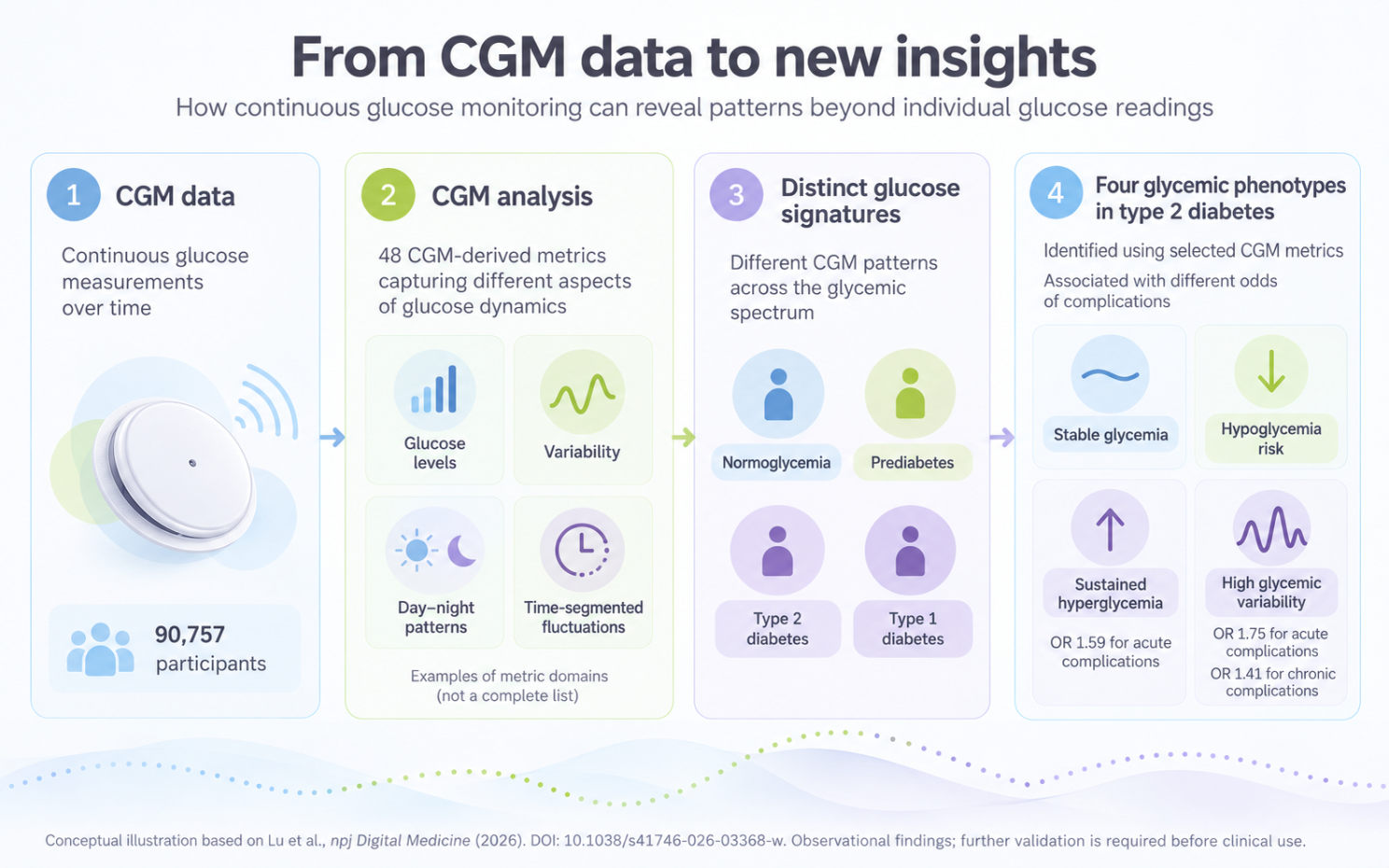
From CGM data to new insights. The study analysed 48 CGM-derived metrics from 90,757 participants and identified distinct glucose patterns across the diabetes spectrum. Among people with type 2 diabetes, four glycemic phenotypes were associated with

From CGM data to new insights. The study analysed 48 CGM-derived metrics from 90,757 participants and identified distinct glucose patterns across the diabetes spectrum. Among people with type 2 diabetes, four glycemic phenotypes were associated with

What could this mean for diabetes care?

Today, CGM systems primarily help people understand what is happening with their glucose levels and respond accordingly. But the enormous amount of data these devices generate may hold additional information that we are only beginning to explore.

By analysing glucose patterns over time, researchers may be able to develop digital biomarkers – measurable indicators derived from digital health data – that could help characterise individual metabolic profiles and identify potential health risks.

In the future, this could support healthcare professionals in recognising people who may benefit from closer monitoring or more personalised treatment approaches.

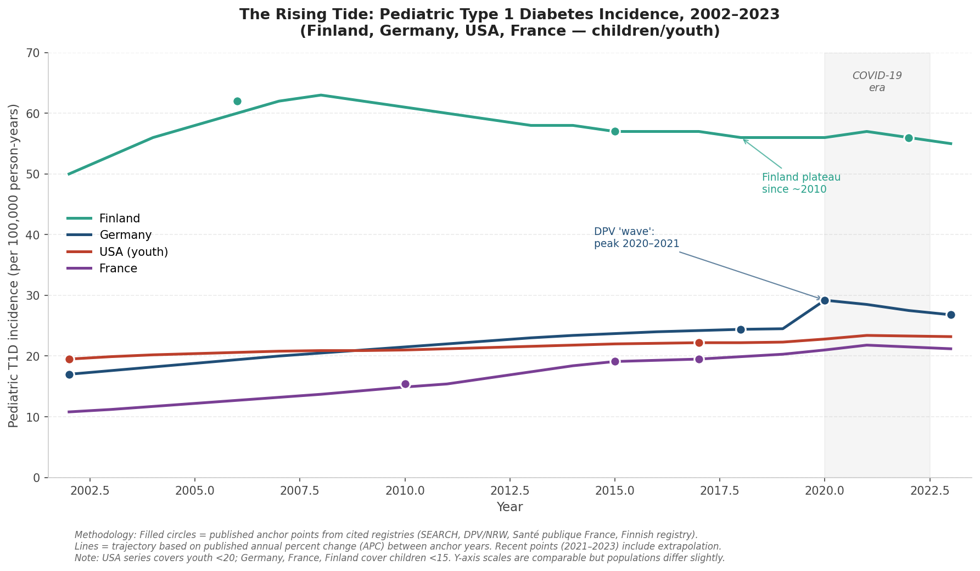
The Nordic region remains the global hotspot for childhood‑onset T1D. Finland has historically reported the highest incidence worldwide – around 60 per 100,000 children per year – although this rate appears to have stabilised or slightly declined since the early 2000s. Sweden, Norway and Denmark follow closely, and the IDF Diabetes Atlas 11 still places Finland, Sweden and Norway among the global top ten for published incidence.

A 2024 systematic review of European paediatric data (1994–2022) confirmed that the Nordic countries retain the highest absolute incidence in Europe, even as their rate of increase has slowed relative to the rapid rise in previously low‑incidence Central and Eastern European countries. A Swedish nationwide cohort study of 2.9 million children found that the heritability of childhood‑onset T1D has remained high and stable at around 0.83 over 30 years, implying that known environmental factors explain less than 10% of the observed rise.

In France, Santé publique France reports an annual T1D incidence increase of approximately 4%. Paediatric incidence rose from 15.4 to 19.1 per 100,000 person‑years between 2010 and 2015, with an overall rate of 19.5 per 100,000 in 2015–2017 and substantial regional variation. Sardinia (Italy) now reports the world’s highest published paediatric incidence at 76.3 per 100,000 (2022), having overtaken Finland, while the United Kingdom and Ireland also remain in the global top ten.
Projections to 2050

Two major modelling efforts suggest the same direction of travel. The GBD 2021 study projects that age‑standardised global type 1 diabetes prevalence will rise by about 23.9% between 2021 and 2050, a smaller relative increase than for type 2 diabetes, but a substantial absolute rise given the lifelong management burden of T1D. The IDF Diabetes Atlas 11 projects that overall adult diabetes prevalence (type 1 and type 2) will grow from 589 million in 2024 to around 853 million by 2050, a 46% absolute increase. While most of this growth is driven by type 2 diabetes, T1D contributes meaningfully through sustained or rising incidence in high‑income countries and improved survival, which increases prevalence even if incidence stabilises.

For the U.S., a modelling exercise based on SEARCH data suggests that, under a linear‑increase scenario, the number of young people with T1D could nearly triple by 2050, with the steepest relative growth among Hispanic and Black children.

Why is incidence rising?

T1D is a polygenic autoimmune disease in which environmental triggers act on a susceptible genetic background. Several, often overlapping, hypotheses are under investigation:

  • Reduced early‑life exposure to common infections (“hygiene hypothesis”), with mixed evidence.
  • Rising childhood adiposity and insulin resistance, which may accelerate the clinical presentation of existing islet autoimmunity (“accelerator hypothesis”).
  • Viral triggers such as enteroviruses and, more recently, SARS‑CoV‑2, where meta‑analyses report a 14–27% increase in paediatric T1D incidence during the pandemic.
  • Dietary and microbiome‑related factors, including early cow’s‑milk exposure, gluten timing and shifts in the infant gut microbiome.
  • Vitamin D status and latitude, endocrine‑disrupting chemicals, pollution and perinatal factors such as higher maternal age, higher birth weight and Caesarean delivery.

The Swedish cohort study mentioned above is a stark reminder of how much remains unexplained: even with population‑wide data on several environmental exposures, less than 10% of the rise in T1D incidence in Sweden could be attributed to known factors. This underscores the need for long‑term birth cohorts, population‑level islet‑autoantibody screening and mechanistic immunology.

Implications for the next decade

Three practical implications stand out for health systems, innovators and the diabetes community:

  • Health systems need to prepare for more people living with type 1 diabetes. Even under conservative assumptions, the number of people living with type 1 diabetes will continue to rise. This has practical consequences for insulin and sensor supply, reimbursement for diabetes technology, specialist care and clinical-trial infrastructure.
  • Early detection is becoming more relevant. Type 1 diabetes can often be detected before symptoms appear, through markers of early autoimmune activity. With the first therapy now approved to delay clinical onset in people at an early disease stage, screening is no longer only a research question. Programmes such as Fr1da in Germany and the D1Ce trial in Italy show how early identification could inform future intervention strategies.
  • We still need to understand why incidence is rising. Many environmental factors are being studied, but no single explanation is sufficient. Until we better understand the drivers behind the increase, true primary prevention will remain out of reach. This makes high-quality registries, long-term cohort studies and coordinated research more important than ever.

At DCB, we see these trends as both a warning and a call to action.

The rising incidence of type 1 diabetes will require sustained collaboration between clinicians, researchers, industry, policymakers and crucially people living with diabetes and their families.

Our work in innovation, clinical research infrastructure and community engagement aims to contribute to that collective effort.

    Selected sources

    GBD 2021 Diabetes Collaborators. Global, regional, and national burden of diabetes from 1990 to 2021, with projections of prevalence to 2050. The Lancet, 2023. https://www.thelancet.com/article/S0140-6736(23)01301-6/fulltext

    International Diabetes Federation. IDF Diabetes Atlas, 11th edition. 2025. https://diabetesatlas.org/

    Ogle GD, et al. Global type 1 diabetes prevalence, incidence, and mortality estimates 2025: Results from the IDF Atlas 11 and the T1D Index v3.0. Diabetes Research and Clinical Practice, 2025. https://www.sciencedirect.com/science/article/pii/S0168822725002918

    Stahl-Pehe A, et al. Wave in Pediatric Type 1 Diabetes Incidence After the Emergence of COVID-19: Peak and Trough Patterns in German Youth — DPV Registry. Diabetes Care, 2025. https://diabetesjournals.org/care/article/48/4/e47/157803/

    Buchmann M, et al. Type 1 diabetes incidence curves differ by age for girls and boys between 1996 and 2022: Results from the North Rhine-Westphalia Diabetes Registry. Diabetes Research and Clinical Practice, 2025. https://www.sciencedirect.com/science/article/pii/S0168822725000105

    Nagl K, et al. Ongoing Increase in Incidence of Diabetes in Austrian Children and Adolescents 1989–2021. Pediatric Diabetes, 2023. https://www.ncbi.nlm.nih.gov/pmc/articles/PMC12017070/

    Schoenle EJ, et al. Epidemiology of Type I diabetes mellitus in Switzerland: Steep rise in incidence in under-5 year old children in the past decade. Diabetologia, 2001. https://www.researchgate.net/publication/12017578

    Santé publique France. Diabetes — Data. Updated 2024. https://www.santepubliquefrance.fr/en/diabete/data

    Piffaretti C, et al. Trends in childhood type 1 diabetes incidence in France, 2010–2015. Diabetes Research and Clinical Practice, 2018. https://www.sciencedirect.com/science/article/abs/pii/S0168822718304662

    Ruiz-Grao MC, et al. Trends in the Incidence of Type 1 Diabetes in European Children and Adolescents from 1994 to 2022: A Systematic Review and Meta-Analysis. Pediatric Diabetes, 2024. https://onlinelibrary.wiley.com/doi/10.1155/2024/2338922

    Ji J, et al. Stable heritability of type 1 diabetes in a Swedish Nationwide Cohort Study. Nature Communications, 2024. https://www.ncbi.nlm.nih.gov/pmc/articles/PMC12174315/

    D’Souza D, et al. Incidence of Diabetes in Children and Adolescents During the COVID-19 Pandemic: A Systematic Review and Meta-Analysis. JAMA Network Open, 2023. https://www.ncbi.nlm.nih.gov/pmc/articles/PMC10314307/

    Quinn LM, et al. Environmental Determinants of Type 1 Diabetes: From Association to Proving Causality. Frontiers in Immunology, 2021. https://www.ncbi.nlm.nih.gov/pmc/articles/PMC8518604/

    Esposito S, et al. Changes in the Global Epidemiology of Type 1 Diabetes in an Evolving Landscape of Environmental Factors. International Journal of Molecular Sciences, 2023. https://www.ncbi.nlm.nih.gov/pmc/articles/PMC10141720/

    Rogers MAM, et al. Fluctuations in the incidence of type 1 diabetes in the United States from 2001 to 2015: a longitudinal study. BMC Medicine, 2017. https://www.ncbi.nlm.nih.gov/pmc/articles/PMC5688827/

    Imperatore G, et al. Projections of Type 1 and Type 2 Diabetes Burden in the U.S. Population Aged <20 Years Through 2050. Diabetes Care, 2012. https://pmc.ncbi.nlm.nih.gov/articles/PMC3507562/


    We hope this overview is helpful for your own work in diabetes care, research or advocacy. As always, we are grateful for your interest in and support of our activities and we look forward to continuing this conversation with you in future editions of our “DID YOU KNOW…” series.


    An earlier version of this article was originally published in the private newsletter of our CEO, Derek Brandt here: Diabetes Technology News.

    This post was previously published in Linkedin. Click here to see the original publication.

    DCB Research AG

    Freiburgstrasse 3
    3010 Bern
    Schweiz

    DCB Newsletter #2/25: DID YOU KNOW… that staying active with Type 1 Diabetes doesn’t have to be complicated?

    DCB Newsletter #2/25: DID YOU KNOW… that staying active with Type 1 Diabetes doesn’t have to be complicated?

    Dear Community,

    For many people living with Type 1 Diabetes (T1D), physical activity can bring unique challenges. Balancing glucose levels, managing insulin, and planning meals around exercise often require extra care and consideration.

    The new book “Empowered: The Science of Exercise with Type 1 Diabetes”, authored by Dr. Sam Scott, CEO and Co-Founder of Enhance-d, and Dr. Simon Helleputte, offers clear and accessible guidance to help you safely and effectively integrate physical activity into your life. Grounded in the latest research, this resource is designed to empower you, no matter your activity level or goals.

    This book is not just about exercise – it’s about empowering you to lead a more active, confident, and fulfilling life while managing your condition. Whether it’s adapting insulin for a morning walk or managing glucose during endurance events, the complexity of physical activity with T1D can feel overwhelming. Empowered bridges the gap between research and everyday life, providing tools and strategies to help you navigate exercise with confidence.

    Who is this book for?

    The e-book is designed to meet the diverse needs of:

    1. People living with Type 1 Diabetes: Whether you’re starting your fitness journey or are an experienced athlete, this guide is tailored to your needs.

    2. Healthcare professionals: Gain insights to better support people with Type 1 Diabetes in their physical activity goals.

    3. Caregivers and coaches: Learn how to provide practical support and encouragement.

    What’s Inside?

    Here’s a glimpse into the book’s ten chapters, crafted to address every key aspect of Type 1 Diabetes and exercise:

    1. Understanding Type 1 Diabetes and exercise: Gain a foundational understanding of how Type 1 Diabetes affects glucose levels during different types of physical activity, including aerobic and anaerobic exercise.

    2. The benefits of physical activity: Discover how regular exercise improves insulin sensitivity, supports cardiovascular health, and enhances overall wellbeing. Learn why even small steps, like reducing sedentary time, can make a big difference.

    3. Hormonal and metabolic responses to exercise: Explore how your body’s natural responses differ with Type 1 Diabetes and how to anticipate and manage fluctuations in glucose levels during and after activity.

    4. Practical exercise management Learn step-by-step approaches to:

    • Adjust insulin doses for various activities
    • Prepare for workouts with tailored nutrition strategies
    • Manage glucose levels during exercise with continuous glucose monitoring (CGM).

    5. Sports science management: For those pursuing endurance sports, delve into advanced topics like low-carbohydrate diets, post-workout recovery, and adaptations for extreme environments.

    And more about Metabolism and management, Sports science principles, Low-carbohydrate diets and Athletic performance in Type 1 Diabetes. Simon and Sam have meticulously compiled the most relevant research to help readers better understand and navigate exercise with Type 1 Diabetes.

    Why this book might be for you?

    1. Research Made Practical: The book translates decades of scientific studies into simple, actionable steps for your daily life.

    2. Real-Life Relevance: It was developed with input from people living with Type 1 Diabetes, ensuring the advice is applicable to real-world scenarios.

    3. Empowering Language: Written in an inclusive and uplifting tone, the book celebrates your strengths and provides solutions for overcoming challenges.

    Ready to Get Started?

    Exclusively for you, dear newsletter readers, we are happy to provide you with a free online version here:

    ➡️ https://book.enhance-d.com/5/empowered

    If you prefer a paperback version, you can get it here:

    ➡️ https://amazon.enhance-d.com/?asin=1068431717

    Join the Empowered Movement

    Connect with a community of people living with Type 1 Diabetes, healthcare professionals, and researchers dedicated to advancing understanding and support for exercise in Type 1 Diabetes management.

    Follow the authors and Enhance-d for updates:

    Key Takeaway

    Managing Type 1 Diabetes doesn’t mean giving up on your fitness goals – it means redefining them with knowledge, preparation, and the right tools. “Empowered” equips you with everything you need to move forward confidently, one step at a time.

    Thanks so much for reading!

    This post was previously published in Linkedin. Click here to see the original publication.

    More recent news

    Sign up for our newsletter
    to receive the latest news.

    * Pflichtfelder
    DSGVO *

    But could the same data tell us much more about a person's health than we currently realise?

    A new study published in npj Digital Medicine suggests that looking beyond individual glucose readings could reveal patterns associated with diabetes-related health risks. The findings point towards an interesting possibility: CGM technology may one day help us understand glucose levels, and also identify individual risk profiles and support more personalised diabetes care.

    What did the researchers discover?

    The researchers analysed CGM data from 90,757 participants in the iCanNet cohort, including people with normoglycemia, prediabetes, type 1 diabetes and type 2 diabetes. Rather than looking at individual glucose values alone, they examined 48 different CGM-derived metrics, including glucose variability and patterns over time. Their analysis revealed distinct glucose patterns across the different groups. Combining several metrics also improved the researchers' ability to distinguish between them.

    Particularly interesting were the findings among people living with type 2 diabetes.

    The researchers identified four distinct glycemic phenotypes – different patterns of glucose levels and fluctuations – associated with varying risks of diabetes-related complications.

    For example:

    • Sustained high glucose levels were associated with a 59% higher relative risk of acute complications.
    • High glucose variability was associated with a 75% higher relative risk of acute complications and a 41% higher relative risk of chronic complications.

    The researchers also developed a Digital Glycemic Risk Score (DGRS), combining multiple CGM metrics to identify people with potentially elevated risks.

    Among participants with type 2 diabetes who had already achieved a Time in Range of at least 70%, the model reclassified 25% into a high-risk category for acute complications and 22.3% into a high-risk category for chronic complications. These were classifications generated by the model, not confirmed predictions of complications occurring in these individuals.

    The findings suggest that combining different glucose patterns may reveal information about health risks that commonly used CGM metrics alone do not fully capture.

    From CGM data to new insights. The study analysed 48 CGM-derived metrics from 90,757 participants and identified distinct glucose patterns across the diabetes spectrum. Among people with type 2 diabetes, four glycemic phenotypes were associated with

    From CGM data to new insights. The study analysed 48 CGM-derived metrics from 90,757 participants and identified distinct glucose patterns across the diabetes spectrum. Among people with type 2 diabetes, four glycemic phenotypes were associated with

    What could this mean for diabetes care?

    Today, CGM systems primarily help people understand what is happening with their glucose levels and respond accordingly. But the enormous amount of data these devices generate may hold additional information that we are only beginning to explore.

    By analysing glucose patterns over time, researchers may be able to develop digital biomarkers – measurable indicators derived from digital health data – that could help characterise individual metabolic profiles and identify potential health risks.

    In the future, this could support healthcare professionals in recognising people who may benefit from closer monitoring or more personalised treatment approaches.

    The Nordic region remains the global hotspot for childhood‑onset T1D. Finland has historically reported the highest incidence worldwide – around 60 per 100,000 children per year – although this rate appears to have stabilised or slightly declined since the early 2000s. Sweden, Norway and Denmark follow closely, and the IDF Diabetes Atlas 11 still places Finland, Sweden and Norway among the global top ten for published incidence.

    A 2024 systematic review of European paediatric data (1994–2022) confirmed that the Nordic countries retain the highest absolute incidence in Europe, even as their rate of increase has slowed relative to the rapid rise in previously low‑incidence Central and Eastern European countries. A Swedish nationwide cohort study of 2.9 million children found that the heritability of childhood‑onset T1D has remained high and stable at around 0.83 over 30 years, implying that known environmental factors explain less than 10% of the observed rise.

    In France, Santé publique France reports an annual T1D incidence increase of approximately 4%. Paediatric incidence rose from 15.4 to 19.1 per 100,000 person‑years between 2010 and 2015, with an overall rate of 19.5 per 100,000 in 2015–2017 and substantial regional variation. Sardinia (Italy) now reports the world’s highest published paediatric incidence at 76.3 per 100,000 (2022), having overtaken Finland, while the United Kingdom and Ireland also remain in the global top ten.

    Projections to 2050

    Two major modelling efforts suggest the same direction of travel. The GBD 2021 study projects that age‑standardised global type 1 diabetes prevalence will rise by about 23.9% between 2021 and 2050, a smaller relative increase than for type 2 diabetes, but a substantial absolute rise given the lifelong management burden of T1D. The IDF Diabetes Atlas 11 projects that overall adult diabetes prevalence (type 1 and type 2) will grow from 589 million in 2024 to around 853 million by 2050, a 46% absolute increase. While most of this growth is driven by type 2 diabetes, T1D contributes meaningfully through sustained or rising incidence in high‑income countries and improved survival, which increases prevalence even if incidence stabilises.

    For the U.S., a modelling exercise based on SEARCH data suggests that, under a linear‑increase scenario, the number of young people with T1D could nearly triple by 2050, with the steepest relative growth among Hispanic and Black children.

    Why is incidence rising?

    T1D is a polygenic autoimmune disease in which environmental triggers act on a susceptible genetic background. Several, often overlapping, hypotheses are under investigation:

    • Reduced early‑life exposure to common infections (“hygiene hypothesis”), with mixed evidence.
    • Rising childhood adiposity and insulin resistance, which may accelerate the clinical presentation of existing islet autoimmunity (“accelerator hypothesis”).
    • Viral triggers such as enteroviruses and, more recently, SARS‑CoV‑2, where meta‑analyses report a 14–27% increase in paediatric T1D incidence during the pandemic.
    • Dietary and microbiome‑related factors, including early cow’s‑milk exposure, gluten timing and shifts in the infant gut microbiome.
    • Vitamin D status and latitude, endocrine‑disrupting chemicals, pollution and perinatal factors such as higher maternal age, higher birth weight and Caesarean delivery.

    The Swedish cohort study mentioned above is a stark reminder of how much remains unexplained: even with population‑wide data on several environmental exposures, less than 10% of the rise in T1D incidence in Sweden could be attributed to known factors. This underscores the need for long‑term birth cohorts, population‑level islet‑autoantibody screening and mechanistic immunology.

    Implications for the next decade

    Three practical implications stand out for health systems, innovators and the diabetes community:

    • Health systems need to prepare for more people living with type 1 diabetes. Even under conservative assumptions, the number of people living with type 1 diabetes will continue to rise. This has practical consequences for insulin and sensor supply, reimbursement for diabetes technology, specialist care and clinical-trial infrastructure.
    • Early detection is becoming more relevant. Type 1 diabetes can often be detected before symptoms appear, through markers of early autoimmune activity. With the first therapy now approved to delay clinical onset in people at an early disease stage, screening is no longer only a research question. Programmes such as Fr1da in Germany and the D1Ce trial in Italy show how early identification could inform future intervention strategies.
    • We still need to understand why incidence is rising. Many environmental factors are being studied, but no single explanation is sufficient. Until we better understand the drivers behind the increase, true primary prevention will remain out of reach. This makes high-quality registries, long-term cohort studies and coordinated research more important than ever.

    At DCB, we see these trends as both a warning and a call to action.

    The rising incidence of type 1 diabetes will require sustained collaboration between clinicians, researchers, industry, policymakers and crucially people living with diabetes and their families.

    Our work in innovation, clinical research infrastructure and community engagement aims to contribute to that collective effort.

      Selected sources

      GBD 2021 Diabetes Collaborators. Global, regional, and national burden of diabetes from 1990 to 2021, with projections of prevalence to 2050. The Lancet, 2023. https://www.thelancet.com/article/S0140-6736(23)01301-6/fulltext

      International Diabetes Federation. IDF Diabetes Atlas, 11th edition. 2025. https://diabetesatlas.org/

      Ogle GD, et al. Global type 1 diabetes prevalence, incidence, and mortality estimates 2025: Results from the IDF Atlas 11 and the T1D Index v3.0. Diabetes Research and Clinical Practice, 2025. https://www.sciencedirect.com/science/article/pii/S0168822725002918

      Stahl-Pehe A, et al. Wave in Pediatric Type 1 Diabetes Incidence After the Emergence of COVID-19: Peak and Trough Patterns in German Youth — DPV Registry. Diabetes Care, 2025. https://diabetesjournals.org/care/article/48/4/e47/157803/

      Buchmann M, et al. Type 1 diabetes incidence curves differ by age for girls and boys between 1996 and 2022: Results from the North Rhine-Westphalia Diabetes Registry. Diabetes Research and Clinical Practice, 2025. https://www.sciencedirect.com/science/article/pii/S0168822725000105

      Nagl K, et al. Ongoing Increase in Incidence of Diabetes in Austrian Children and Adolescents 1989–2021. Pediatric Diabetes, 2023. https://www.ncbi.nlm.nih.gov/pmc/articles/PMC12017070/

      Schoenle EJ, et al. Epidemiology of Type I diabetes mellitus in Switzerland: Steep rise in incidence in under-5 year old children in the past decade. Diabetologia, 2001. https://www.researchgate.net/publication/12017578

      Santé publique France. Diabetes — Data. Updated 2024. https://www.santepubliquefrance.fr/en/diabete/data

      Piffaretti C, et al. Trends in childhood type 1 diabetes incidence in France, 2010–2015. Diabetes Research and Clinical Practice, 2018. https://www.sciencedirect.com/science/article/abs/pii/S0168822718304662

      Ruiz-Grao MC, et al. Trends in the Incidence of Type 1 Diabetes in European Children and Adolescents from 1994 to 2022: A Systematic Review and Meta-Analysis. Pediatric Diabetes, 2024. https://onlinelibrary.wiley.com/doi/10.1155/2024/2338922

      Ji J, et al. Stable heritability of type 1 diabetes in a Swedish Nationwide Cohort Study. Nature Communications, 2024. https://www.ncbi.nlm.nih.gov/pmc/articles/PMC12174315/

      D’Souza D, et al. Incidence of Diabetes in Children and Adolescents During the COVID-19 Pandemic: A Systematic Review and Meta-Analysis. JAMA Network Open, 2023. https://www.ncbi.nlm.nih.gov/pmc/articles/PMC10314307/

      Quinn LM, et al. Environmental Determinants of Type 1 Diabetes: From Association to Proving Causality. Frontiers in Immunology, 2021. https://www.ncbi.nlm.nih.gov/pmc/articles/PMC8518604/

      Esposito S, et al. Changes in the Global Epidemiology of Type 1 Diabetes in an Evolving Landscape of Environmental Factors. International Journal of Molecular Sciences, 2023. https://www.ncbi.nlm.nih.gov/pmc/articles/PMC10141720/

      Rogers MAM, et al. Fluctuations in the incidence of type 1 diabetes in the United States from 2001 to 2015: a longitudinal study. BMC Medicine, 2017. https://www.ncbi.nlm.nih.gov/pmc/articles/PMC5688827/

      Imperatore G, et al. Projections of Type 1 and Type 2 Diabetes Burden in the U.S. Population Aged <20 Years Through 2050. Diabetes Care, 2012. https://pmc.ncbi.nlm.nih.gov/articles/PMC3507562/


      We hope this overview is helpful for your own work in diabetes care, research or advocacy. As always, we are grateful for your interest in and support of our activities and we look forward to continuing this conversation with you in future editions of our “DID YOU KNOW…” series.


      An earlier version of this article was originally published in the private newsletter of our CEO, Derek Brandt here: Diabetes Technology News.

      This post was previously published in Linkedin. Click here to see the original publication.

      DCB Research AG

      Freiburgstrasse 3
      3010 Bern
      Schweiz

      DCB Open Innovation Challenge 2025: Meet our Top 5!

      DCB Open Innovation Challenge 2025: Meet our Top 5!

      DCB Open Innovation Challenge 2025: Meet our Top 5!

      The DCB Open Innovation Challenge 2025 is proceeding to the next round! We are very happy to announce the Top 5 who rocked the stage at our Pitch Day and impressed our esteemed jury with their ideas.

      Meet our Top 5!

      After a thorough review of 54 remarkable submissions for our Open Innovation Challenge, 15 promising teams were invited to present their ideas live at our Pitch Day.

      Following an exciting day of pitches and innovation, we are thrilled to announce the 5 finalists who impressed the jury and secured their place in this year’s exclusive bootcamp and a chance to shine at our awards event.

      We encourage you to discover the full profiles of our top 5 innovators in the attached PDF or down below!

      Join us in celebrating their incredible journey, and secure your ticket for the Day of Innovation to witness the finale in person: https://lnkd.in/dH-8n3v5

      Downloads

      Alva Innovations Inc. (US) - In-line, just-in-time insulin fibril filtration — NO skin irritation!

      Alva Innovations has developed a just-in-time filtration platform that removes insulin fibrils during pump therapy, thereby prolonging the lifespan of pump sets and maintaining healthy skin.

      Neuraura (CAN) - LoOoP by Neuraura: proactive management of diabetes risk in PCOS population (polycystic ovary syndrome)

      LoOoP by Neuraura is a first in-kind solution for PCOS (polycystic ovary syndrome), combining a biowearable with a digital platform. 70% of individuals with PCOS develop insulin resistance and 50% develop pre-/diabetes before 40.

      YW MEMS (CHN) - Insulin patch pump drive

      The MEMS MicroPump Module offers a highly integrated, precise, accurate and secure technology for insulin infusion, empowering the miniaturization and intelligent precision control for insulin pump.

      SynchNeuro (USA) - Brain signal-based non-invasive glucose monitor

      SynchNeuro offers a discreet, brain-signal-based wearable and app for continuous glucose and cardiometabolic monitoring, targeting prediabetic and type 2 diabetes adults for $10/month.

      Diawiser (LTU) - Diawiser

      Diawiser is a non-invasive software that detects blood glucose abnormalities with voice.

      More recent news

      Sign up for our newsletter
      to receive the latest news.

      * Pflichtfelder
      DSGVO *

      But could the same data tell us much more about a person's health than we currently realise?

      A new study published in npj Digital Medicine suggests that looking beyond individual glucose readings could reveal patterns associated with diabetes-related health risks. The findings point towards an interesting possibility: CGM technology may one day help us understand glucose levels, and also identify individual risk profiles and support more personalised diabetes care.

      What did the researchers discover?

      The researchers analysed CGM data from 90,757 participants in the iCanNet cohort, including people with normoglycemia, prediabetes, type 1 diabetes and type 2 diabetes. Rather than looking at individual glucose values alone, they examined 48 different CGM-derived metrics, including glucose variability and patterns over time. Their analysis revealed distinct glucose patterns across the different groups. Combining several metrics also improved the researchers' ability to distinguish between them.

      Particularly interesting were the findings among people living with type 2 diabetes.

      The researchers identified four distinct glycemic phenotypes – different patterns of glucose levels and fluctuations – associated with varying risks of diabetes-related complications.

      For example:

      • Sustained high glucose levels were associated with a 59% higher relative risk of acute complications.
      • High glucose variability was associated with a 75% higher relative risk of acute complications and a 41% higher relative risk of chronic complications.

      The researchers also developed a Digital Glycemic Risk Score (DGRS), combining multiple CGM metrics to identify people with potentially elevated risks.

      Among participants with type 2 diabetes who had already achieved a Time in Range of at least 70%, the model reclassified 25% into a high-risk category for acute complications and 22.3% into a high-risk category for chronic complications. These were classifications generated by the model, not confirmed predictions of complications occurring in these individuals.

      The findings suggest that combining different glucose patterns may reveal information about health risks that commonly used CGM metrics alone do not fully capture.

      From CGM data to new insights. The study analysed 48 CGM-derived metrics from 90,757 participants and identified distinct glucose patterns across the diabetes spectrum. Among people with type 2 diabetes, four glycemic phenotypes were associated with

      From CGM data to new insights. The study analysed 48 CGM-derived metrics from 90,757 participants and identified distinct glucose patterns across the diabetes spectrum. Among people with type 2 diabetes, four glycemic phenotypes were associated with

      What could this mean for diabetes care?

      Today, CGM systems primarily help people understand what is happening with their glucose levels and respond accordingly. But the enormous amount of data these devices generate may hold additional information that we are only beginning to explore.

      By analysing glucose patterns over time, researchers may be able to develop digital biomarkers – measurable indicators derived from digital health data – that could help characterise individual metabolic profiles and identify potential health risks.

      In the future, this could support healthcare professionals in recognising people who may benefit from closer monitoring or more personalised treatment approaches.

      The Nordic region remains the global hotspot for childhood‑onset T1D. Finland has historically reported the highest incidence worldwide – around 60 per 100,000 children per year – although this rate appears to have stabilised or slightly declined since the early 2000s. Sweden, Norway and Denmark follow closely, and the IDF Diabetes Atlas 11 still places Finland, Sweden and Norway among the global top ten for published incidence.

      A 2024 systematic review of European paediatric data (1994–2022) confirmed that the Nordic countries retain the highest absolute incidence in Europe, even as their rate of increase has slowed relative to the rapid rise in previously low‑incidence Central and Eastern European countries. A Swedish nationwide cohort study of 2.9 million children found that the heritability of childhood‑onset T1D has remained high and stable at around 0.83 over 30 years, implying that known environmental factors explain less than 10% of the observed rise.

      In France, Santé publique France reports an annual T1D incidence increase of approximately 4%. Paediatric incidence rose from 15.4 to 19.1 per 100,000 person‑years between 2010 and 2015, with an overall rate of 19.5 per 100,000 in 2015–2017 and substantial regional variation. Sardinia (Italy) now reports the world’s highest published paediatric incidence at 76.3 per 100,000 (2022), having overtaken Finland, while the United Kingdom and Ireland also remain in the global top ten.

      Projections to 2050

      Two major modelling efforts suggest the same direction of travel. The GBD 2021 study projects that age‑standardised global type 1 diabetes prevalence will rise by about 23.9% between 2021 and 2050, a smaller relative increase than for type 2 diabetes, but a substantial absolute rise given the lifelong management burden of T1D. The IDF Diabetes Atlas 11 projects that overall adult diabetes prevalence (type 1 and type 2) will grow from 589 million in 2024 to around 853 million by 2050, a 46% absolute increase. While most of this growth is driven by type 2 diabetes, T1D contributes meaningfully through sustained or rising incidence in high‑income countries and improved survival, which increases prevalence even if incidence stabilises.

      For the U.S., a modelling exercise based on SEARCH data suggests that, under a linear‑increase scenario, the number of young people with T1D could nearly triple by 2050, with the steepest relative growth among Hispanic and Black children.

      Why is incidence rising?

      T1D is a polygenic autoimmune disease in which environmental triggers act on a susceptible genetic background. Several, often overlapping, hypotheses are under investigation:

      • Reduced early‑life exposure to common infections (“hygiene hypothesis”), with mixed evidence.
      • Rising childhood adiposity and insulin resistance, which may accelerate the clinical presentation of existing islet autoimmunity (“accelerator hypothesis”).
      • Viral triggers such as enteroviruses and, more recently, SARS‑CoV‑2, where meta‑analyses report a 14–27% increase in paediatric T1D incidence during the pandemic.
      • Dietary and microbiome‑related factors, including early cow’s‑milk exposure, gluten timing and shifts in the infant gut microbiome.
      • Vitamin D status and latitude, endocrine‑disrupting chemicals, pollution and perinatal factors such as higher maternal age, higher birth weight and Caesarean delivery.

      The Swedish cohort study mentioned above is a stark reminder of how much remains unexplained: even with population‑wide data on several environmental exposures, less than 10% of the rise in T1D incidence in Sweden could be attributed to known factors. This underscores the need for long‑term birth cohorts, population‑level islet‑autoantibody screening and mechanistic immunology.

      Implications for the next decade

      Three practical implications stand out for health systems, innovators and the diabetes community:

      • Health systems need to prepare for more people living with type 1 diabetes. Even under conservative assumptions, the number of people living with type 1 diabetes will continue to rise. This has practical consequences for insulin and sensor supply, reimbursement for diabetes technology, specialist care and clinical-trial infrastructure.
      • Early detection is becoming more relevant. Type 1 diabetes can often be detected before symptoms appear, through markers of early autoimmune activity. With the first therapy now approved to delay clinical onset in people at an early disease stage, screening is no longer only a research question. Programmes such as Fr1da in Germany and the D1Ce trial in Italy show how early identification could inform future intervention strategies.
      • We still need to understand why incidence is rising. Many environmental factors are being studied, but no single explanation is sufficient. Until we better understand the drivers behind the increase, true primary prevention will remain out of reach. This makes high-quality registries, long-term cohort studies and coordinated research more important than ever.

      At DCB, we see these trends as both a warning and a call to action.

      The rising incidence of type 1 diabetes will require sustained collaboration between clinicians, researchers, industry, policymakers and crucially people living with diabetes and their families.

      Our work in innovation, clinical research infrastructure and community engagement aims to contribute to that collective effort.

        Selected sources

        GBD 2021 Diabetes Collaborators. Global, regional, and national burden of diabetes from 1990 to 2021, with projections of prevalence to 2050. The Lancet, 2023. https://www.thelancet.com/article/S0140-6736(23)01301-6/fulltext

        International Diabetes Federation. IDF Diabetes Atlas, 11th edition. 2025. https://diabetesatlas.org/

        Ogle GD, et al. Global type 1 diabetes prevalence, incidence, and mortality estimates 2025: Results from the IDF Atlas 11 and the T1D Index v3.0. Diabetes Research and Clinical Practice, 2025. https://www.sciencedirect.com/science/article/pii/S0168822725002918

        Stahl-Pehe A, et al. Wave in Pediatric Type 1 Diabetes Incidence After the Emergence of COVID-19: Peak and Trough Patterns in German Youth — DPV Registry. Diabetes Care, 2025. https://diabetesjournals.org/care/article/48/4/e47/157803/

        Buchmann M, et al. Type 1 diabetes incidence curves differ by age for girls and boys between 1996 and 2022: Results from the North Rhine-Westphalia Diabetes Registry. Diabetes Research and Clinical Practice, 2025. https://www.sciencedirect.com/science/article/pii/S0168822725000105

        Nagl K, et al. Ongoing Increase in Incidence of Diabetes in Austrian Children and Adolescents 1989–2021. Pediatric Diabetes, 2023. https://www.ncbi.nlm.nih.gov/pmc/articles/PMC12017070/

        Schoenle EJ, et al. Epidemiology of Type I diabetes mellitus in Switzerland: Steep rise in incidence in under-5 year old children in the past decade. Diabetologia, 2001. https://www.researchgate.net/publication/12017578

        Santé publique France. Diabetes — Data. Updated 2024. https://www.santepubliquefrance.fr/en/diabete/data

        Piffaretti C, et al. Trends in childhood type 1 diabetes incidence in France, 2010–2015. Diabetes Research and Clinical Practice, 2018. https://www.sciencedirect.com/science/article/abs/pii/S0168822718304662

        Ruiz-Grao MC, et al. Trends in the Incidence of Type 1 Diabetes in European Children and Adolescents from 1994 to 2022: A Systematic Review and Meta-Analysis. Pediatric Diabetes, 2024. https://onlinelibrary.wiley.com/doi/10.1155/2024/2338922

        Ji J, et al. Stable heritability of type 1 diabetes in a Swedish Nationwide Cohort Study. Nature Communications, 2024. https://www.ncbi.nlm.nih.gov/pmc/articles/PMC12174315/

        D’Souza D, et al. Incidence of Diabetes in Children and Adolescents During the COVID-19 Pandemic: A Systematic Review and Meta-Analysis. JAMA Network Open, 2023. https://www.ncbi.nlm.nih.gov/pmc/articles/PMC10314307/

        Quinn LM, et al. Environmental Determinants of Type 1 Diabetes: From Association to Proving Causality. Frontiers in Immunology, 2021. https://www.ncbi.nlm.nih.gov/pmc/articles/PMC8518604/

        Esposito S, et al. Changes in the Global Epidemiology of Type 1 Diabetes in an Evolving Landscape of Environmental Factors. International Journal of Molecular Sciences, 2023. https://www.ncbi.nlm.nih.gov/pmc/articles/PMC10141720/

        Rogers MAM, et al. Fluctuations in the incidence of type 1 diabetes in the United States from 2001 to 2015: a longitudinal study. BMC Medicine, 2017. https://www.ncbi.nlm.nih.gov/pmc/articles/PMC5688827/

        Imperatore G, et al. Projections of Type 1 and Type 2 Diabetes Burden in the U.S. Population Aged <20 Years Through 2050. Diabetes Care, 2012. https://pmc.ncbi.nlm.nih.gov/articles/PMC3507562/


        We hope this overview is helpful for your own work in diabetes care, research or advocacy. As always, we are grateful for your interest in and support of our activities and we look forward to continuing this conversation with you in future editions of our “DID YOU KNOW…” series.


        An earlier version of this article was originally published in the private newsletter of our CEO, Derek Brandt here: Diabetes Technology News.

        This post was previously published in Linkedin. Click here to see the original publication.

        DCB Research AG

        Freiburgstrasse 3
        3010 Bern
        Schweiz