DCB Newsletter #5/26: DID YOU KNOW… CGM data could reveal more than glucose levels?
Dear DCB Community,
Continuous glucose monitoring (CGM) has changed the way people manage diabetes. Glucose readings, trends and alerts provide valuable information that helps people with diabetes and healthcare professionals make informed decisions every day.

But could the same data tell us much more about a person’s health than we currently realise?
A new study published in npj Digital Medicine suggests that looking beyond individual glucose readings could reveal patterns associated with diabetes-related health risks. The findings point towards an interesting possibility: CGM technology may one day help us understand glucose levels, and also identify individual risk profiles and support more personalised diabetes care.
What did the researchers discover?
The researchers analysed CGM data from 90,757 participants in the iCanNet cohort, including people with normoglycemia, prediabetes, type 1 diabetes and type 2 diabetes. Rather than looking at individual glucose values alone, they examined 48 different CGM-derived metrics, including glucose variability and patterns over time. Their analysis revealed distinct glucose patterns across the different groups. Combining several metrics also improved the researchers’ ability to distinguish between them.
Particularly interesting were the findings among people living with type 2 diabetes.
The researchers identified four distinct glycemic phenotypes – different patterns of glucose levels and fluctuations – associated with varying risks of diabetes-related complications.
For example:
- Sustained high glucose levels were associated with a 59% higher relative risk of acute complications.
- High glucose variability was associated with a 75% higher relative risk of acute complications and a 41% higher relative risk of chronic complications.
The researchers also developed a Digital Glycemic Risk Score (DGRS), combining multiple CGM metrics to identify people with potentially elevated risks.
Among participants with type 2 diabetes who had already achieved a Time in Range of at least 70%, the model reclassified 25% into a high-risk category for acute complications and 22.3% into a high-risk category for chronic complications. These were classifications generated by the model, not confirmed predictions of complications occurring in these individuals.
The findings suggest that combining different glucose patterns may reveal information about health risks that commonly used CGM metrics alone do not fully capture.
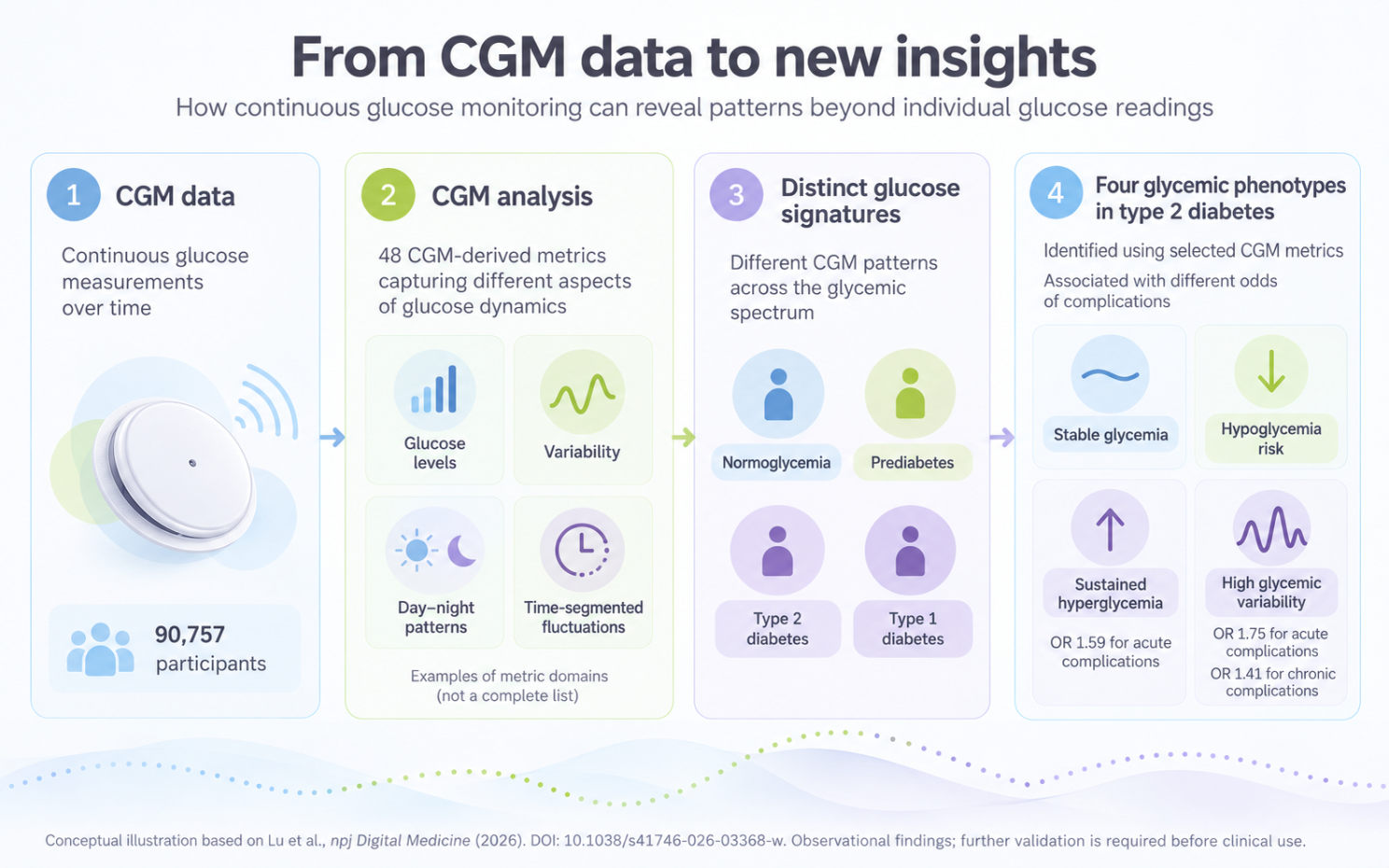
From CGM data to new insights. The study analysed 48 CGM-derived metrics from 90,757 participants and identified distinct glucose patterns across the diabetes spectrum. Among people with type 2 diabetes, four glycemic phenotypes were associated with
What could this mean for diabetes care?
Today, CGM systems primarily help people understand what is happening with their glucose levels and respond accordingly. But the enormous amount of data these devices generate may hold additional information that we are only beginning to explore.
By analysing glucose patterns over time, researchers may be able to develop digital biomarkers – measurable indicators derived from digital health data – that could help characterise individual metabolic profiles and identify potential health risks.
In the future, this could support healthcare professionals in recognising people who may benefit from closer monitoring or more personalised treatment approaches.

The goal should not be to generate more data, but to turn existing data into meaningful information that makes diabetes management easier and supports better decisions.
However, the study is an important step in research, not proof that these approaches are ready for everyday clinical use.
The findings still need to be validated in other populations and tested prospectively. Further research must also determine whether using these risk profiles to guide clinical decisions actually improves health outcomes.
Looking ahead: The future of CGM technology
For years, advances in CGM technology have focused on improving sensor accuracy, wear time, comfort and connectivity. These developments remain essential.
But this study highlights another promising direction: the value of CGM technology may increasingly depend on what we can learn from the data it generates.
As data analysis and algorithms advance, glucose sensors could potentially become part of a broader approach to understanding metabolic health and supporting more personalised care.
This also creates new opportunities for researchers, healthcare professionals and technology developers. The challenge will be to translate complex data into reliable, clinically meaningful insights, without adding unnecessary complexity to diabetes management.
Why is this relevant to DCB?
At the Diabetes Center Berne, we focus on advancing diabetes technology through research, clinical development, data science and innovation. Understanding how technology can better address the needs of people living with diabetes is central to our work.
Research like this highlights why innovation in diabetes technology about developing better devices as well as making better use of the information these devices already provide.
Combining advances in sensor technology with intelligent data analysis could open up new opportunities for personalised diabetes care. But for these approaches to make a meaningful difference, they need to be scientifically validated, clinically useful and designed around the needs of the people who will use them.

Thanks for reading and stay tuned for more insights from our “DID YOU KNOW…” series!
Original research
Lu, J., Ding, Y., Zhao, B. et al. (2026). Multidimensional continuous glucose monitoring metrics enable digital risk stratification across the diabetes spectrum. npj Digital Medicine. Published 13 October 2026.
https://doi.org/10.1038/s41746-026-03368-w
This article is adapted from an original contribution to the newsletter of Derek Brandt, CEO of the Diabetes Center Berne.
This post was previously published in Linkedin. Click here to see the original publication.


DCB Research AG
Freiburgstrasse 3
3010 Bern
Schweiz