Voices of the community
How do we identify what people with diabetes really need? By involving them of course! That’s exactly why we have established the DCB Lived Experience Panel. By actively listening to the voices of the diabetes community, we want to ensure that the ideas we help develop are truly person-centric.

Meet the DCB Lived Experience Panel!

Switzerland
Vivien Glocker
Vivien is a physician and doctoral candidate active in pediatric type 1 diabetes research and clinical care. She has international experience in type 1 diabetes research (U.S.A., Germany, Switzerland) and has volunteered in diabetes kids camps and events. Her master thesis about the subject “fear of hypoglycemia and quality of life in young people with type 1 diabetes and their parents in the era of sensor glucose monitoring”was published as a first author in the scientific journal Frontiers in 2022.
She is passionate to contribute to the diabetes community, clinical and research field of type 1 diabetes.

U.K.
Niki Breslin
After an initial misdiagnosis of Type 2 Diabetes, Niki has lived with T1D for 23 years. A mother to 3 under the age of 6, Niki is involved in a variety or peer support groups, research advisories and projects aimed specifically at the preconception, pregnancy, postpartum and parenting stages of life with T1D, as well as a general focus on women’s health. Within her advocacy journey Niki is always keen to ensure balanced conversations free of stigma and misconceptions around living with any type of diabetes, believing this has the ability to empower and embolden other people living with Diabetes to make informed choices about their lives. Niki is currently developing a Language Matters Pregnancy and Diabetes document with support from a team of healthcare professionals and others with lived experience, this is a great opportunity to involve specialties within the healthcare system that don’t have explicit understanding of diabetes.

India
Deeksha Dev
Deeksha is a Diabetes Psychologist and a Certified Diabetes Educator who has lived experience of 24 years with Type 1 Diabetes. She works with the Diabesties Foundation as their Director of Advocacy and Experiences wherein she gets the chance of giving back to the community by counselling, educating and empowering them. She also represents India under the Young Leaders in Diabetes programme by the International Diabetes Federation and she is also a #dedoc° voice.
She was invited by IDF to speak about ‘Mental Health and Diabetes’ on the occasion of World Mental Health Day and by #dedoc° to speak about the same on World Diabetes Day.
Deeksha created a project called ‘Unwind’ which aims to create a safe space for everyone to begin a dialogue about living with diabetes and its impact on one’s mental health. She primarily works to raise the profile of Type 1 Diabetes in the community (with stakeholders), outside the community to create awareness about Type 1 Diabetes and a stigma free environment for us all and to ensure that mental health is included in all the conversations around Diabetes. Her sole aim is to create a space at the table for lived experience when Mental Health and Diabetes is being addressed anywhere in the world.

U.K.
Isabelle Newman
Isabelle has been living with type 1 diabetes since the age of 9. She is currently studying Medicine at the University of Manchester and is passionate about making technology available to all people living with diabetes. She has walked the 12 Bridges Challenge for Diabetes UK and cycled as many kilometres as she had been weeks diagnosed, raising almost £4000 in the process. She wants to empower people living with diabetes at all stages and has currently worked closely with children who have just been diagnosed and their families, answering questions and providing a friendly, knowledgeable face, as a healthcare assistant in hospitals.

U.K.
Emma Doble
Emma was diagnosed with type 1 diabetes at the age of 4 and struggled to manage it growing up. She set up and developed a number of projects to initiate peer support for young people with type 1 including a project using drama to help young people talk about their experience with diabetes. Emma works at the BMJ leading on their patient and public partnership strategy. Her interest in patient partnership began when she began working with her local diabetes team to review, and redesign, the diabetes service whilst completing her MSc in Health Psychology. She also works with Cochrane UK, JDRF UK, Diabetes Scotland and the Scottish Government guiding them on patient partnership.

India
Jazz Sethi
Jazz Sethi is the founder and director of The Diabesties Foundation – a global movement to make those with Type 1 Diabetes feel heard, understood, supported and celebrated – with a dedicated youtube channel, monthly meet ups, Awareness tours, education programs, access and advocacy drives and several other creative projects. She was diagnosed with Type 1 Diabetes when she was 13 and currently in on Pump, CGM and DIY Loop. She lives in India.
She was the IDF’s Young Leader of Diabetes for South East Asia for 2019-2022 term representing India. The Diabesties Foundation works closely with Diabetes India, RSSDI, and NHS England for developing projects and publications. Jazz is also a certified diabetes educator and did her training with the IDF program.
She is also a professional dancer, choreographer, theatre artist and a published author. She completed her training from Broadway Dance Center in New York and the AEF from Florence. Her mantra is simple – Live Happily and Bolus Regularly.

India
Mridula Kapil Bhargava
Mridula has been living with type 1 diabetes for over 30 years and is the founder of Diabetes Fighters’ Trust, a not-for-profit focused upon prevention as well as better management of Diabetes in urban and rural India using the concept of community ownership. In 2021, she won the “Diabetes Storytelling Lab in India 2021”, has been selected as a #dedoc° voice 2023 and sits at several National and International Advisory panels including CAP-Medicines Patent Pool, NCD Advisory Board- FINDdx, Member-WHO Global Diabetes Compact, Associate Member-Healthy India Alliance.

U.S.
Crystal Diaz
Crystal has been living with type 1 diabetes since 2019 and is passionate about uplifting patients’ lived experiences, especially those of people of color. She recently graduated from the University of California, Davis with her Bachelor of Science in Global Disease Biology with plans to become a physician assistant. Her diabetes advocacy started in 2021 with the Diabetes Link NextGen Fellowship program where she found inspiration and confidence in living with diabetes. Since then, she has volunteered with Children with Diabetes at their Friends for Life Orlando conference, spoke about mental health and stigma in diabetes for Diversity in Diabetes, and represented patient voices for the DiabetesMine Innovation Days. Crystal hopes her advocacy will encourage others to feel understood and empowered, creating a safe space for them to share their lived experiences.

Switzerland
Shanelle Glocker
Shanelle is committed to fostering the promotion and international collaboration of start-ups in the field of health and diabetes technology. She supports internationally active non-profit organisations such as JDRF.

U.S.
Claudia Lewis
Claudia is an endocrinology physician assistant (PA) who has had type 1 diabetes since the age of 12. She works both in the hospital and clinic taking care of patients with diabetes. Her research experience includes serving as a co-investigator for the development of a simulation platform for diabetes self-management and technology education. She has spoken at the Association of Diabetes Care and Education Specialists conference on empowering young adults with diabetes. She was also identified as a Diabetes Link NextGen Leader and was awarded the 2022 DiabetesMine Patient Voices scholarship. Her passion is connecting with people with diabetes and providing them with education and support to help them live their highest quality life.
Singapore
Candy Gan
Candy has been living with Type 1 Diabetes (T1D) since the age of two, but dived into advocacy work during university. In 2017, she delivered two TEDx talks about her T1D experiences (Accountability is not Responsibility; Towards a Patient-Centered Care System: A View From Chronic Illness) and worked with JDRF UK and Diabetes UK to raise awareness of the importance of patient voice. In 2022, she co-authored Singapore’s first bilingual children’s picture book based on real-life patients’ stories of their diagnoses and learnings. The book, “My Name is Adam. I have Type 1 Diabetes” is available in English and Mandarin, and has been distributed nation-wide to primary schools, kindergartens, child care centres, and public libraries. This book is her endeavour to give those with T1D a resource she wished she had as a child. She volunteers for the local T1D community typeOne.sg – a community of T1D families in Singapore.
Switzerland
Laura Burlando
Laura is a patient advocate living with type 1 diabetes, passionate about improving the lives of people with diabetes and bringing in the patient voice. She’s currently studying a Master’s Degree in Health Sciences to deepen her knowledge of the healthcare system and complement her own experience navigating it as a patient. In the future, she hopes to incorporate the knowledge she gained from my studies as well as her lived experience to better address the unmet needs of people living with diabetes. Laura is part of the Diabetes Online Community as well as #dedoc°, an international network of diabetes patient advocates, and frequently shares her ups and downs with type 1 diabetes online. She also enjoys working with different industry partners on type 1 diabetes.
Germany
Lea Raak
Lea is an activist and patient expert for chronic diseases and disabilities. Diagnosed with type 1 diabetes herself since 2011, she has been involved in a variety of international projects on the topic of type 1 diabetes for many years, focusing on the psychological component of the disease and combating social prejudice. As a speaker, she regularly does educational work, especially in the field of digital health. Her professional background is in international cooperation with a focus on gender and disability studies.
South Africa
Thapi Semenya
Thapi is passionate about advocacy and has been living with diabetes for 16 years. She uses her social media accounts to educate about her multiple chronic conditions namely diabetes, vitiligo and bipolar disorder. Passionate about advocating for access to basic diabetes management needs and affordability to diabetes technologies, Thapi is currently studying Law and is planning to specialise in health law. Thapi started advocating in 2018 when she realised that she wanted to form a community and allow for a space where people living with diabetes can come together and share their hopes and struggles. Her volunteer work includes working with a Glasgow based charity committed to raising awareness of and supporting disabled young people called The Luna Project UK as a Professional Advisor. Thapi is moreover a #dedoc° voice, a trainee in the IDF Young Leaders in Diabetes programme for 2022-2024. and volunteers as part of Media & Communications for Mutual Aid Diabetes

Sweden/Switzerland
Hanna Boëthius
Hanna is originally from Sweden but lives in Switzerland. She has been living with type 1 diabetes as her “constant companion” for 37 years, and says that her diabetes has also become her biggest teacher. Through her own company, Hanna Diabetes Expert, she consults various companies, has public speaking engagements and workshops – all focused on the topic of diabetes and being a patient. Hanna believes there is power in sharing your story and experience living with chronic conditions, like type 1 diabetes, and she aims to do this through her work, as well as social media. She currently writing her dissertation for a MSc Diabetes from the University of Leicester, UK.

Australia
Leon Tribe
Leon is a person with Type 1 Diabetes (LADA) living in Sydney, Australia. As well as a first class honours degree in physics, Leon has an MBA in strategy and leadership. For his day job, Leon works as a presales Solution Advisor for a large software implementation company, frequently presenting technical solutions to non-technical audiences. Leon was a top 20 finalist in the DCB Innovation Challenge 2022 and is an active member of the #dedoc° Voices programme. Having attended conferences such as ATTD and EASD on multiple occasions, Leon communicates the latest research to the wider diabetes community through social media, providing the patient’s perspective and translating complex medical research into accessible information.
Spain/Argentina
Lucía Feito Allonca
Diagnosed with type 1 diabetes more than three decades ago in 1992, Lucía stands as a dynamic force dedicated to catalyzing positive change in the global diabetes landscape.

Italy/Switzerland
Laura Magnabosco
Laura is originally from Italy, but currently residing in Switzerland as she pursues her PhD in the field of diabetes research. Laura’s journey with diabetes began at the age of 14 when she was diagnosed with type 1 diabetes. Her diagnosis ignited a spark within her for scientific exploration and a deep fascination with the intricate workings of the human body.
Driven by this passion, she embarked on a path of academic excellence, majoring in Medical Biotechnology at university. Her thirst for knowledge led her to pursue a doctoral degree, specializing in diabetes research. Laura is profoundly committed to her work in the lab, where she engages in cutting-edgepre-clinical research. Her ultimate goal is to make a substantial and positive impact on thelives of those affected by diabetes.
Recently she has recognized the immense value in sharing experiences and insights with others who face the same challenges. This newfound awareness has inspired her to extend her knowledge and experiences beyond the laboratory. She believes in the transformative power of shared experiences and hopes to harness it for the betterment of individuals living with diabetes.

Switzerland
Nadine Schenk
Nadine was diagnosed with Type 1 diabetes in 2011. After completing two vocational trainings as an ornamental plant and landscape gardener, she went on to study social pedagogy. Nadine is committed to ensuring that people with diabetes who also live with physical, cognitive, or psychological impairments receive more targeted support and guidance. She is also dedicated to promoting the development of new technologies and tools that make everyday life easier for people with diabetes and disabilities. In addition, Nadine serves on the board of Diabetes Bern. Her personal experiences with diabetes, as well as more insights into her interests and goals for the community, can also be heard in episode 3 of the Club D podcast by Diabetes Switzerland.

Switzerland
Natalia Román
Natalia is originally from Spain but living in Switzerland for over a decade. She was diagnosed with type 1 diabetes as a young adult in 2019. Despite her diabetes, Natalia continues to be an endurance mountain athlete. Either on running shoes or touring skis, nature is her ‘therapy’ to cope with the ups and downs of managing diabetes 24/7. In recent times, Natalia’s career in marketing and communications took a turn towards entrepreneurship! At Brand Labs GmbH she supports players in healthcare & medtech market their life-changing innovations. Collaborating with diabetes tech clients provides her the opportunity to foster patient-centric thinking and communication.
Become part of the DCB Lived Experience Panel!
Contact us if want you to become one of our Lived Experience Experts and therefore a part of our international community of innovators, experts, researchers and people with diabetes from all over the world. We look forward to hearing from you!
But could the same data tell us much more about a person's health than we currently realise?
A new study published in npj Digital Medicine suggests that looking beyond individual glucose readings could reveal patterns associated with diabetes-related health risks. The findings point towards an interesting possibility: CGM technology may one day help us understand glucose levels, and also identify individual risk profiles and support more personalised diabetes care.
What did the researchers discover?
The researchers analysed CGM data from 90,757 participants in the iCanNet cohort, including people with normoglycemia, prediabetes, type 1 diabetes and type 2 diabetes. Rather than looking at individual glucose values alone, they examined 48 different CGM-derived metrics, including glucose variability and patterns over time. Their analysis revealed distinct glucose patterns across the different groups. Combining several metrics also improved the researchers' ability to distinguish between them.
Particularly interesting were the findings among people living with type 2 diabetes.
The researchers identified four distinct glycemic phenotypes – different patterns of glucose levels and fluctuations – associated with varying risks of diabetes-related complications.
For example:
- Sustained high glucose levels were associated with a 59% higher relative risk of acute complications.
- High glucose variability was associated with a 75% higher relative risk of acute complications and a 41% higher relative risk of chronic complications.
The researchers also developed a Digital Glycemic Risk Score (DGRS), combining multiple CGM metrics to identify people with potentially elevated risks.
Among participants with type 2 diabetes who had already achieved a Time in Range of at least 70%, the model reclassified 25% into a high-risk category for acute complications and 22.3% into a high-risk category for chronic complications. These were classifications generated by the model, not confirmed predictions of complications occurring in these individuals.
The findings suggest that combining different glucose patterns may reveal information about health risks that commonly used CGM metrics alone do not fully capture.
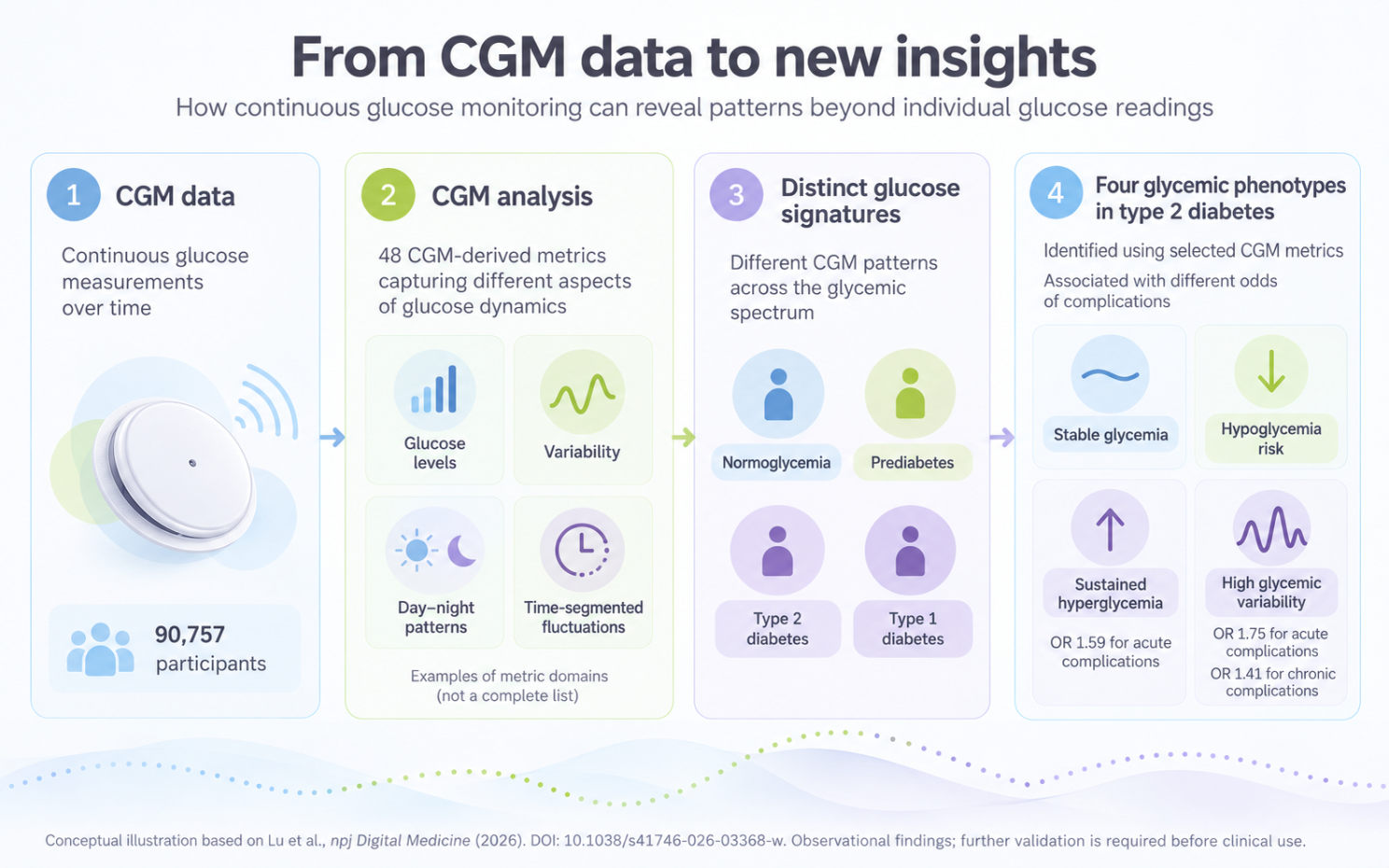
From CGM data to new insights. The study analysed 48 CGM-derived metrics from 90,757 participants and identified distinct glucose patterns across the diabetes spectrum. Among people with type 2 diabetes, four glycemic phenotypes were associated with
What could this mean for diabetes care?
Today, CGM systems primarily help people understand what is happening with their glucose levels and respond accordingly. But the enormous amount of data these devices generate may hold additional information that we are only beginning to explore.
By analysing glucose patterns over time, researchers may be able to develop digital biomarkers – measurable indicators derived from digital health data – that could help characterise individual metabolic profiles and identify potential health risks.
In the future, this could support healthcare professionals in recognising people who may benefit from closer monitoring or more personalised treatment approaches.

The Nordic region remains the global hotspot for childhood‑onset T1D. Finland has historically reported the highest incidence worldwide – around 60 per 100,000 children per year – although this rate appears to have stabilised or slightly declined since the early 2000s. Sweden, Norway and Denmark follow closely, and the IDF Diabetes Atlas 11 still places Finland, Sweden and Norway among the global top ten for published incidence.
A 2024 systematic review of European paediatric data (1994–2022) confirmed that the Nordic countries retain the highest absolute incidence in Europe, even as their rate of increase has slowed relative to the rapid rise in previously low‑incidence Central and Eastern European countries. A Swedish nationwide cohort study of 2.9 million children found that the heritability of childhood‑onset T1D has remained high and stable at around 0.83 over 30 years, implying that known environmental factors explain less than 10% of the observed rise.
In France, Santé publique France reports an annual T1D incidence increase of approximately 4%. Paediatric incidence rose from 15.4 to 19.1 per 100,000 person‑years between 2010 and 2015, with an overall rate of 19.5 per 100,000 in 2015–2017 and substantial regional variation. Sardinia (Italy) now reports the world’s highest published paediatric incidence at 76.3 per 100,000 (2022), having overtaken Finland, while the United Kingdom and Ireland also remain in the global top ten.
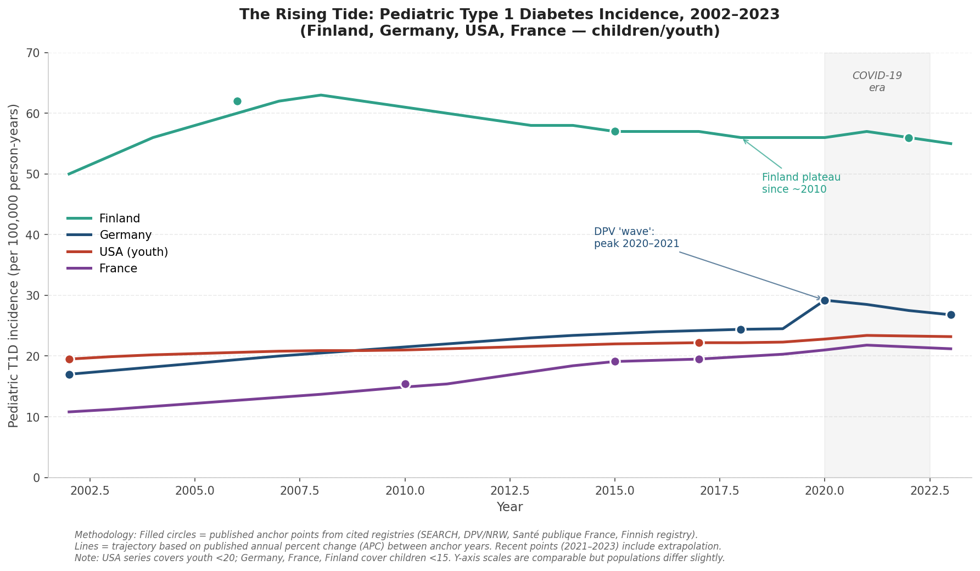
Projections to 2050
Two major modelling efforts suggest the same direction of travel. The GBD 2021 study projects that age‑standardised global type 1 diabetes prevalence will rise by about 23.9% between 2021 and 2050, a smaller relative increase than for type 2 diabetes, but a substantial absolute rise given the lifelong management burden of T1D. The IDF Diabetes Atlas 11 projects that overall adult diabetes prevalence (type 1 and type 2) will grow from 589 million in 2024 to around 853 million by 2050, a 46% absolute increase. While most of this growth is driven by type 2 diabetes, T1D contributes meaningfully through sustained or rising incidence in high‑income countries and improved survival, which increases prevalence even if incidence stabilises.
For the U.S., a modelling exercise based on SEARCH data suggests that, under a linear‑increase scenario, the number of young people with T1D could nearly triple by 2050, with the steepest relative growth among Hispanic and Black children.
Why is incidence rising?
T1D is a polygenic autoimmune disease in which environmental triggers act on a susceptible genetic background. Several, often overlapping, hypotheses are under investigation:
- Reduced early‑life exposure to common infections (“hygiene hypothesis”), with mixed evidence.
- Rising childhood adiposity and insulin resistance, which may accelerate the clinical presentation of existing islet autoimmunity (“accelerator hypothesis”).
- Viral triggers such as enteroviruses and, more recently, SARS‑CoV‑2, where meta‑analyses report a 14–27% increase in paediatric T1D incidence during the pandemic.
- Dietary and microbiome‑related factors, including early cow’s‑milk exposure, gluten timing and shifts in the infant gut microbiome.
- Vitamin D status and latitude, endocrine‑disrupting chemicals, pollution and perinatal factors such as higher maternal age, higher birth weight and Caesarean delivery.
The Swedish cohort study mentioned above is a stark reminder of how much remains unexplained: even with population‑wide data on several environmental exposures, less than 10% of the rise in T1D incidence in Sweden could be attributed to known factors. This underscores the need for long‑term birth cohorts, population‑level islet‑autoantibody screening and mechanistic immunology.
Implications for the next decade
Three practical implications stand out for health systems, innovators and the diabetes community:
- Health systems need to prepare for more people living with type 1 diabetes. Even under conservative assumptions, the number of people living with type 1 diabetes will continue to rise. This has practical consequences for insulin and sensor supply, reimbursement for diabetes technology, specialist care and clinical-trial infrastructure.
- Early detection is becoming more relevant. Type 1 diabetes can often be detected before symptoms appear, through markers of early autoimmune activity. With the first therapy now approved to delay clinical onset in people at an early disease stage, screening is no longer only a research question. Programmes such as Fr1da in Germany and the D1Ce trial in Italy show how early identification could inform future intervention strategies.
- We still need to understand why incidence is rising. Many environmental factors are being studied, but no single explanation is sufficient. Until we better understand the drivers behind the increase, true primary prevention will remain out of reach. This makes high-quality registries, long-term cohort studies and coordinated research more important than ever.
At DCB, we see these trends as both a warning and a call to action.
The rising incidence of type 1 diabetes will require sustained collaboration between clinicians, researchers, industry, policymakers and crucially people living with diabetes and their families.
Our work in innovation, clinical research infrastructure and community engagement aims to contribute to that collective effort.
Selected sources
GBD 2021 Diabetes Collaborators. Global, regional, and national burden of diabetes from 1990 to 2021, with projections of prevalence to 2050. The Lancet, 2023. https://www.thelancet.com/article/S0140-6736(23)01301-6/fulltext
International Diabetes Federation. IDF Diabetes Atlas, 11th edition. 2025. https://diabetesatlas.org/
Ogle GD, et al. Global type 1 diabetes prevalence, incidence, and mortality estimates 2025: Results from the IDF Atlas 11 and the T1D Index v3.0. Diabetes Research and Clinical Practice, 2025. https://www.sciencedirect.com/science/article/pii/S0168822725002918
Stahl-Pehe A, et al. Wave in Pediatric Type 1 Diabetes Incidence After the Emergence of COVID-19: Peak and Trough Patterns in German Youth — DPV Registry. Diabetes Care, 2025. https://diabetesjournals.org/care/article/48/4/e47/157803/
Buchmann M, et al. Type 1 diabetes incidence curves differ by age for girls and boys between 1996 and 2022: Results from the North Rhine-Westphalia Diabetes Registry. Diabetes Research and Clinical Practice, 2025. https://www.sciencedirect.com/science/article/pii/S0168822725000105
Nagl K, et al. Ongoing Increase in Incidence of Diabetes in Austrian Children and Adolescents 1989–2021. Pediatric Diabetes, 2023. https://www.ncbi.nlm.nih.gov/pmc/articles/PMC12017070/
Schoenle EJ, et al. Epidemiology of Type I diabetes mellitus in Switzerland: Steep rise in incidence in under-5 year old children in the past decade. Diabetologia, 2001. https://www.researchgate.net/publication/12017578
Santé publique France. Diabetes — Data. Updated 2024. https://www.santepubliquefrance.fr/en/diabete/data
Piffaretti C, et al. Trends in childhood type 1 diabetes incidence in France, 2010–2015. Diabetes Research and Clinical Practice, 2018. https://www.sciencedirect.com/science/article/abs/pii/S0168822718304662
Ruiz-Grao MC, et al. Trends in the Incidence of Type 1 Diabetes in European Children and Adolescents from 1994 to 2022: A Systematic Review and Meta-Analysis. Pediatric Diabetes, 2024. https://onlinelibrary.wiley.com/doi/10.1155/2024/2338922
Ji J, et al. Stable heritability of type 1 diabetes in a Swedish Nationwide Cohort Study. Nature Communications, 2024. https://www.ncbi.nlm.nih.gov/pmc/articles/PMC12174315/
D’Souza D, et al. Incidence of Diabetes in Children and Adolescents During the COVID-19 Pandemic: A Systematic Review and Meta-Analysis. JAMA Network Open, 2023. https://www.ncbi.nlm.nih.gov/pmc/articles/PMC10314307/
Quinn LM, et al. Environmental Determinants of Type 1 Diabetes: From Association to Proving Causality. Frontiers in Immunology, 2021. https://www.ncbi.nlm.nih.gov/pmc/articles/PMC8518604/
Esposito S, et al. Changes in the Global Epidemiology of Type 1 Diabetes in an Evolving Landscape of Environmental Factors. International Journal of Molecular Sciences, 2023. https://www.ncbi.nlm.nih.gov/pmc/articles/PMC10141720/
Rogers MAM, et al. Fluctuations in the incidence of type 1 diabetes in the United States from 2001 to 2015: a longitudinal study. BMC Medicine, 2017. https://www.ncbi.nlm.nih.gov/pmc/articles/PMC5688827/
Imperatore G, et al. Projections of Type 1 and Type 2 Diabetes Burden in the U.S. Population Aged <20 Years Through 2050. Diabetes Care, 2012. https://pmc.ncbi.nlm.nih.gov/articles/PMC3507562/
We hope this overview is helpful for your own work in diabetes care, research or advocacy. As always, we are grateful for your interest in and support of our activities and we look forward to continuing this conversation with you in future editions of our “DID YOU KNOW…” series.
An earlier version of this article was originally published in the private newsletter of our CEO, Derek Brandt here: Diabetes Technology News.
This post was previously published in Linkedin. Click here to see the original publication.

DCB Research AG
Freiburgstrasse 3
3010 Bern
Schweiz