DCB and Tidepool investigated how menstrual cycle phases relate to insulin needs, glycemic outcomes and insulin...

Menstrual Cycle Study: Results published in Diabetes Care
Menstrual Cycle Study: Results published in Diabetes Care
DCB and Tidepool investigated how menstrual cycle phases relate to insulin needs, glycemic outcomes and insulin sensitivity in people with type 1 diabetes using automated insulin delivery systems.

Menstrual Cycle Study
The Menstrual Cycle Study was conducted in collaboration between Tidepool and the Diabetes Center Berne (DCB). The retrospective decentralized study analysed real-world data donated by 77 menstruating adults with type 1 diabetes using automated insulin delivery systems.
In total, the dataset covered 380 menstrual cycles and 10,107 days of data from continuous glucose monitoring, insulin delivery, carbohydrate intake and menstrual cycle tracking.
The findings have been published in Diabetes Care, a journal of the American Diabetes Association.
Study results
The study investigated how insulin needs, glycemic outcomes and insulin sensitivity vary across menstrual cycle phases. Cycle phase-specific variation in insulin sensitivity was estimated using a hierarchical Bayesian state-space model.
The results show systematic phase-dependent variation in insulin requirements, carbohydrate intake, glycemic outcomes and model-derived insulin sensitivity.
menstruating adults with type 1 diabetes included in the analysis
menstrual cycles covered by the real-world dataset
days of data from CGM, insulin delivery, carbohydrate intake and cycle tracking
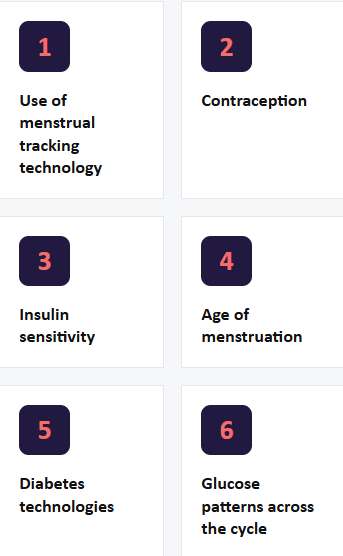
Visual abstract
PARTICIPANTS AND DATA
77 adults, 380 cycles
Real-world AID, CGM, insulin delivery, carbohydrate intake and menstrual cycle tracking data.
CYCLE PHASES
Early follicular phase (period) to midluteal phase
The analysis compared phase-specific patterns across the menstrual cycle.
MAIN SIGNAL
Insulin sensitivity and glucose outcomes varied by phase
- Higher insulin sensitivity early in the cycle
- Higher insulin needs around the midluteal phase
- Individual variability remained substantial
Key findings
Early follicular phase (period)
Model-derived estimates indicated the highest population-level insulin sensitivity in the early follicular phase, at +2.6% relative to the population average.
Midluteal phase
Total daily insulin dose and carbohydrate intake increased across the cycle and were elevated around the midluteal phase. Model-derived insulin sensitivity was lowest in the midluteal phase, at -2.6% relative to the population average.
Luteal phases
Mean glucose and time above range were higher, while time in range and time in tight range were lower during parts of the luteal phase.
Across individuals
Most participants broadly followed the population-level trend: 84.7% showed above-average insulin sensitivity in the early follicular phase and below-average insulin sensitivity in the midluteal phase, but the magnitude varied considerably.
Why this matters
The findings suggest that menstrual cycle-related physiology remains relevant for glycemic regulation, even in people using automated insulin delivery systems.
They also suggest that current automated insulin delivery systems do not fully compensate for menstrual cycle-related fluctuations in insulin needs and glycemic outcomes.
What the study does not show
The study does not provide individual treatment recommendations and does not suggest that menstrual cycle effects are the same for everyone. As an observational study, it identifies patterns and variability, but causal conclusions remain limited.
Building on this work, the TIMES study is designed to determine cycle phases more precisely using ovulation tests and to capture additional factors that may influence insulin sensitivity.
Publication
Hossmann S, Friedman M, Lizoain A, Caduff M, Braunack-Mayer V, Burlando L, Lal RA, Cengiz E, Braune K, Reger-Tan S, Knopf A-C, Zueger T, Khan-Gallo S, Rothenbuehler M, et al.
Effects of menstrual cycle on insulin sensitivity in type 1 diabetes: an observational study of individuals using an automated insulin delivery system.
Diabetes Care. 2026;49(9):1673-1680. DOI: 10.2337/dc26-0692
Building on this research: the TIMES study
Building on these findings, DCB is continuing this line of research through the TIMES study, which investigates how insulin requirements change across the menstrual cycle in women with type 1 diabetes.
TIMES will help define cycle phases more precisely through ovulation testing and collect additional contextual information that may influence insulin sensitivity, supporting a more detailed understanding of individual variability.
Contact
Menstrual Cycle Study Team
The RIPPLE study
A Tidepool Big Data Donation Project Study that brings together diabetes
device data, wearable signals, and health survey responses to explore how
everyday aspects of life, like sleep, activity, stress, and hormonal changes, can
create ripple effects across the diabetes spectrum.
Your participation helps build one of the most comprehensive real-world
pictures of life with diabetes across the full spectrum of experience, informing
better tools for the whole community.
In collaboration With Oura, eligible participants receive a complimentary
refurbished Oura Ring Gen3.
Study Partners
The Menstrual Cycle Study was conducted by Tidepool and the Diabetes Center Berne, with contributions from international research partners.

More recent projects

Menstrual Cycle Study: Results published in Diabetes Care
SPN-005 – Pilot study on painless glucose monitoring
Towards painless, needle-free glucose monitoring for people with Type 1 Diabetes.Project description:For people with...
Insulin Activity Project
Exploring Insulin Stability and Activity in Diabetes ManagementInsulin is essential for diabetes management, but its...


DCB Research AG
Freiburgstrasse 3
3010 Bern
Schweiz