DCB Newsletter #14/23: IT’S A WRAP! A Recap of the 2023 DCB Open Innovation Challenge
Dear community – We are happy to provide you with a new episode of our newsletter series and give you some insights into our DCB Innovation Challenge. Enjoy the read!

The DCB Open Innovation Challenge
The DCB Open Innovation Challenge is an opportunity for anyone with an innovative solution to change diabetes management. It only takes an idea to participate for anyone – whether a healthcare professional, a start-up, a person living with diabetes or others. Those who share their ideas receive sparring and feedback from experts. It all culminates in the DCB Start-Up night, where we award the winners for both categories. The DCB Open Innovation Challenge award is one of the world’s most generous and renowned diabetes-related awards.
This year, incredible 66 ideas were submitted to the challenge, with three finalists in each category. These six finalists from the U.S., the U.K., Switzerland, Ireland, South Africa and France pitched their projects live on stage in Bern in front of 300 guests and an international jury, who then chose the winner of each category.
But how exactly did we get here and what did the DCB Open Innovation Challenge look like? Read all about the journey below.
Our Top 20 in the Categories “Diabetes Devices” and “Digital Diabetes”
Before we were able to select our top 3 in each category to travel to our bootcamp and the much-anticipated DCB Start-Up Night, we selected our Top 20 per category:
The Top 20 of each category received mentoring from chosen experts of our network on various topics, ranging from co-creation experts to regulatory specialists. Additionally, we hosted a Pitch Training session before their big Pitch Day, where they could network and learn from our experts as well as their peers about how to improve their pitch and convince our jury.
The Innovation Bootcamp – 4 intense days of learning and networking in the Swiss Alps
To get ready for the DCB Start-Up Night with pitches and winners’ celebrations, we took all six finalists to a bootcamp in the Swiss Alps. Over the course of four days, we spent our time 1300 meters above sea level with a stunning view and mentoring, pitch training, 1:1 coaching, filming image videos (which were played during the Start-Up Night and we can’t wait to show you soon here on LinkedIn!) and of course, with many fruitful discussions and lots of networking.
But see for yourself! Our friends at Newsroom Communication were with us every step of the way and prepared a highlight clip to give you a glimpse behind the scenes:
The Winners of 2023
On November 9, this year’s DCB Start-Up Night and Award Ceremony of the Open Innovation Challenge 2023 took place. After an exciting evening of pitching, an international jury chose the winners of the third edition of the Open Innovation ChallengeThe first prizes of 100.000 USD in funding and in-kind support each went to MYNERVA (Switzerland) in the category Diabetes Devices and to Spotlight-AQ (U.K.) in the category Digital Diabetes.
MYNERVA, winner of the category Diabetes Devices, is developing a unique wearable device for people living with diabetic neuropathy. The device restores the sense of touch and decreases pain through a non-invasive electrical nerve stimulation driven by AI algorithms.
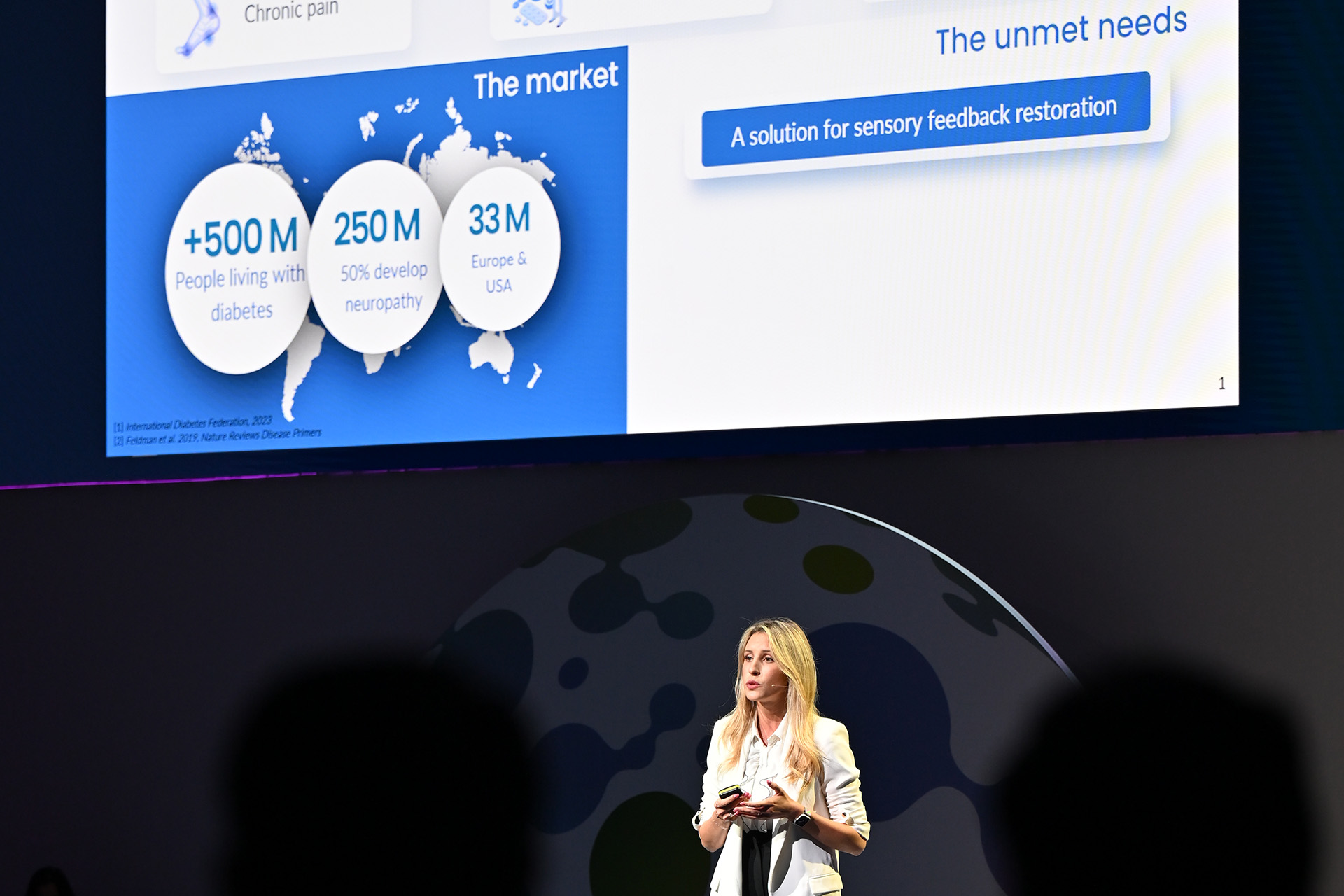
In her pitch, CEO Greta Preatoni emphasised the impact this can have on people’s quality of live, giving them back the ability to walk with more ease and without pain. After winning first place for Diabetes Devices, she shared:
Spotlight-AQ, winner of the category Digital Diabetes, is on a mission to improve routine visits by helping people with diabetes to feel heard and doctors feel empowered to care. It is a novel validated infographic assessment platform highlighting user priority concerns and immediate mapped resources to meet those unmet needs.

In her pitch, CSO Katharine Barnard-Kelly PhD emphasised the role this can play within the constraints of existing healthcare systems and structures, benefiting people with diabetes, while reducing burnout among treating physicians. After winning first place for Digital Diabetes, she shared:
While the winners of the challenge received 100,000 USD in funding and in-kind support, the four remaining finalists – Fada Medical, ECLYPIA, Gluroo Imaginations Inc. and Africa Diabetes Chat (by Sweet Life Diabetes Community) – received 20.000 USD each, consisting of 10.000 USD in funding and 10.000 USD in-kind support.

All 6 finalists on stage with host Renza Scibilia
It’s been a wonderful few months with the cohort of this year’s DCB Open Innovation Challenge and we are already eagerly awaiting next year’s! As Katharine Barnard, winner of the category Digital Diabetes put it:
Now it’s your turn – it’s never too early to start brainstorming ideas for the next challenge. We’re excited to see what you come up with!”
Thanks so much for reading and we’ll provide you with the next episode of this series soon!
This edition was authored by Svea Krutisch, Digital Communications Specialist at DCB.
This post was previously published in Linkedin. Click here to see the original publication.
More recent news

New endowed lectureship investigates the role of the gut microbiome in obesity and diabetes
Thanks to the support of the Diabetes Center Berne (DCB), the University of Bern is establishing a new endowed...

Four DCB professorships advance research in diabetes technology
32 publications, 37 conference contributions and over CHF 6 million in research funding: the four professorships at...

SNAQ Launches the First AI Nutritionist for CGM Users Managing Diabetes
SNAQ has announced the release of its AI Nutritionist, a first-of-its-kind digital companion designed to help people...
But could the same data tell us much more about a person's health than we currently realise?
A new study published in npj Digital Medicine suggests that looking beyond individual glucose readings could reveal patterns associated with diabetes-related health risks. The findings point towards an interesting possibility: CGM technology may one day help us understand glucose levels, and also identify individual risk profiles and support more personalised diabetes care.
What did the researchers discover?
The researchers analysed CGM data from 90,757 participants in the iCanNet cohort, including people with normoglycemia, prediabetes, type 1 diabetes and type 2 diabetes. Rather than looking at individual glucose values alone, they examined 48 different CGM-derived metrics, including glucose variability and patterns over time. Their analysis revealed distinct glucose patterns across the different groups. Combining several metrics also improved the researchers' ability to distinguish between them.
Particularly interesting were the findings among people living with type 2 diabetes.
The researchers identified four distinct glycemic phenotypes – different patterns of glucose levels and fluctuations – associated with varying risks of diabetes-related complications.
For example:
- Sustained high glucose levels were associated with a 59% higher relative risk of acute complications.
- High glucose variability was associated with a 75% higher relative risk of acute complications and a 41% higher relative risk of chronic complications.
The researchers also developed a Digital Glycemic Risk Score (DGRS), combining multiple CGM metrics to identify people with potentially elevated risks.
Among participants with type 2 diabetes who had already achieved a Time in Range of at least 70%, the model reclassified 25% into a high-risk category for acute complications and 22.3% into a high-risk category for chronic complications. These were classifications generated by the model, not confirmed predictions of complications occurring in these individuals.
The findings suggest that combining different glucose patterns may reveal information about health risks that commonly used CGM metrics alone do not fully capture.
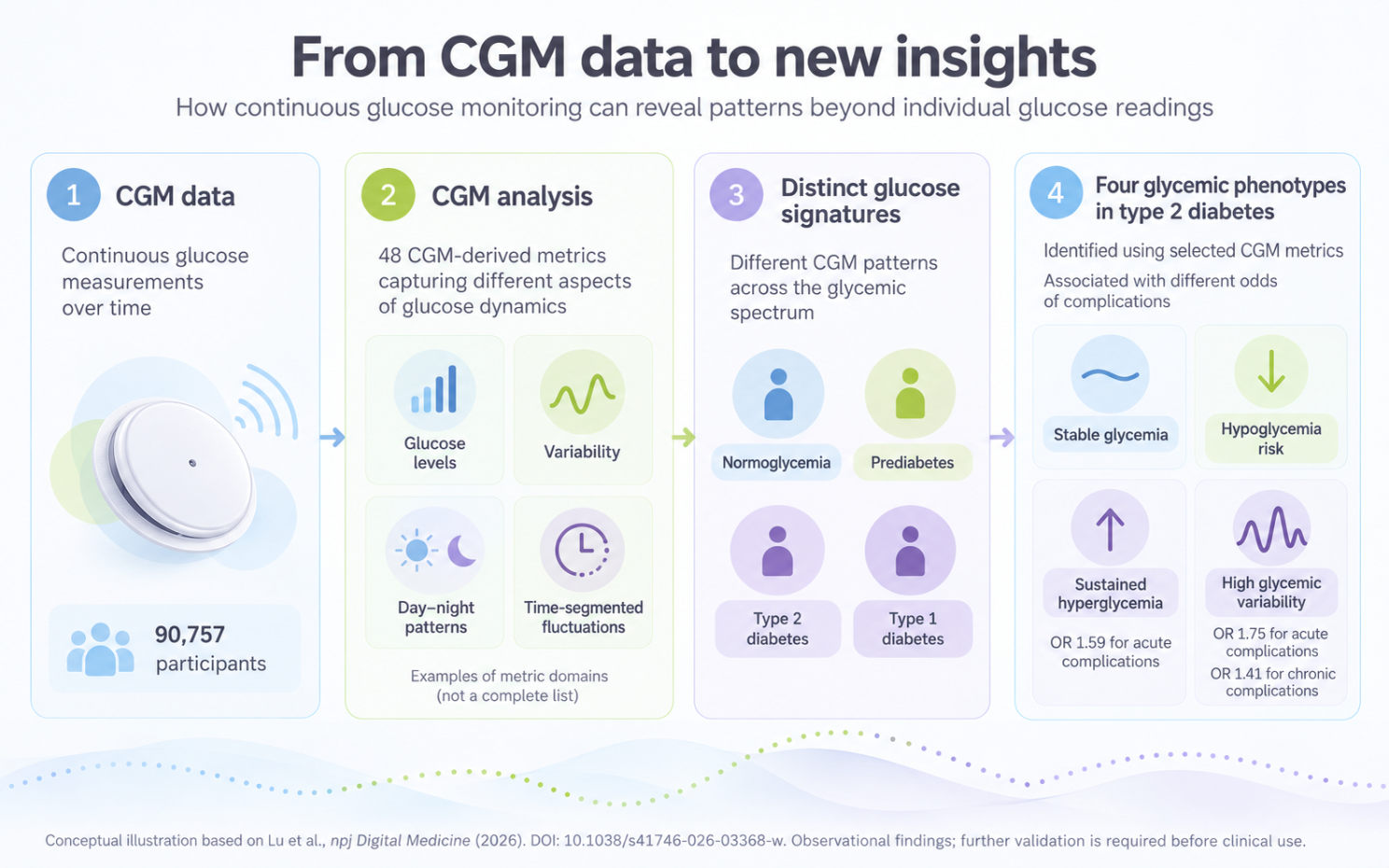
From CGM data to new insights. The study analysed 48 CGM-derived metrics from 90,757 participants and identified distinct glucose patterns across the diabetes spectrum. Among people with type 2 diabetes, four glycemic phenotypes were associated with
What could this mean for diabetes care?
Today, CGM systems primarily help people understand what is happening with their glucose levels and respond accordingly. But the enormous amount of data these devices generate may hold additional information that we are only beginning to explore.
By analysing glucose patterns over time, researchers may be able to develop digital biomarkers – measurable indicators derived from digital health data – that could help characterise individual metabolic profiles and identify potential health risks.
In the future, this could support healthcare professionals in recognising people who may benefit from closer monitoring or more personalised treatment approaches.

The Nordic region remains the global hotspot for childhood‑onset T1D. Finland has historically reported the highest incidence worldwide – around 60 per 100,000 children per year – although this rate appears to have stabilised or slightly declined since the early 2000s. Sweden, Norway and Denmark follow closely, and the IDF Diabetes Atlas 11 still places Finland, Sweden and Norway among the global top ten for published incidence.
A 2024 systematic review of European paediatric data (1994–2022) confirmed that the Nordic countries retain the highest absolute incidence in Europe, even as their rate of increase has slowed relative to the rapid rise in previously low‑incidence Central and Eastern European countries. A Swedish nationwide cohort study of 2.9 million children found that the heritability of childhood‑onset T1D has remained high and stable at around 0.83 over 30 years, implying that known environmental factors explain less than 10% of the observed rise.
In France, Santé publique France reports an annual T1D incidence increase of approximately 4%. Paediatric incidence rose from 15.4 to 19.1 per 100,000 person‑years between 2010 and 2015, with an overall rate of 19.5 per 100,000 in 2015–2017 and substantial regional variation. Sardinia (Italy) now reports the world’s highest published paediatric incidence at 76.3 per 100,000 (2022), having overtaken Finland, while the United Kingdom and Ireland also remain in the global top ten.
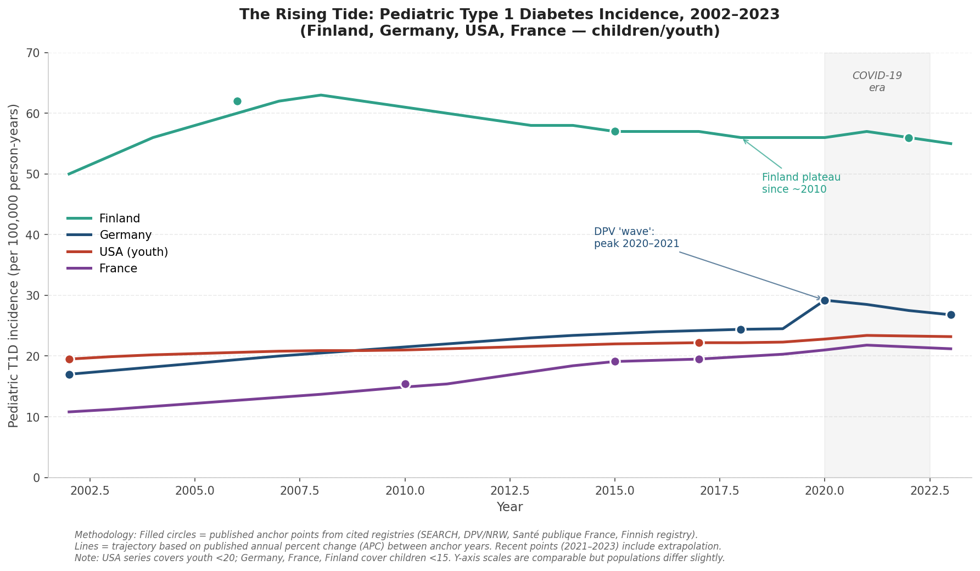
Projections to 2050
Two major modelling efforts suggest the same direction of travel. The GBD 2021 study projects that age‑standardised global type 1 diabetes prevalence will rise by about 23.9% between 2021 and 2050, a smaller relative increase than for type 2 diabetes, but a substantial absolute rise given the lifelong management burden of T1D. The IDF Diabetes Atlas 11 projects that overall adult diabetes prevalence (type 1 and type 2) will grow from 589 million in 2024 to around 853 million by 2050, a 46% absolute increase. While most of this growth is driven by type 2 diabetes, T1D contributes meaningfully through sustained or rising incidence in high‑income countries and improved survival, which increases prevalence even if incidence stabilises.
For the U.S., a modelling exercise based on SEARCH data suggests that, under a linear‑increase scenario, the number of young people with T1D could nearly triple by 2050, with the steepest relative growth among Hispanic and Black children.
Why is incidence rising?
T1D is a polygenic autoimmune disease in which environmental triggers act on a susceptible genetic background. Several, often overlapping, hypotheses are under investigation:
- Reduced early‑life exposure to common infections (“hygiene hypothesis”), with mixed evidence.
- Rising childhood adiposity and insulin resistance, which may accelerate the clinical presentation of existing islet autoimmunity (“accelerator hypothesis”).
- Viral triggers such as enteroviruses and, more recently, SARS‑CoV‑2, where meta‑analyses report a 14–27% increase in paediatric T1D incidence during the pandemic.
- Dietary and microbiome‑related factors, including early cow’s‑milk exposure, gluten timing and shifts in the infant gut microbiome.
- Vitamin D status and latitude, endocrine‑disrupting chemicals, pollution and perinatal factors such as higher maternal age, higher birth weight and Caesarean delivery.
The Swedish cohort study mentioned above is a stark reminder of how much remains unexplained: even with population‑wide data on several environmental exposures, less than 10% of the rise in T1D incidence in Sweden could be attributed to known factors. This underscores the need for long‑term birth cohorts, population‑level islet‑autoantibody screening and mechanistic immunology.
Implications for the next decade
Three practical implications stand out for health systems, innovators and the diabetes community:
- Health systems need to prepare for more people living with type 1 diabetes. Even under conservative assumptions, the number of people living with type 1 diabetes will continue to rise. This has practical consequences for insulin and sensor supply, reimbursement for diabetes technology, specialist care and clinical-trial infrastructure.
- Early detection is becoming more relevant. Type 1 diabetes can often be detected before symptoms appear, through markers of early autoimmune activity. With the first therapy now approved to delay clinical onset in people at an early disease stage, screening is no longer only a research question. Programmes such as Fr1da in Germany and the D1Ce trial in Italy show how early identification could inform future intervention strategies.
- We still need to understand why incidence is rising. Many environmental factors are being studied, but no single explanation is sufficient. Until we better understand the drivers behind the increase, true primary prevention will remain out of reach. This makes high-quality registries, long-term cohort studies and coordinated research more important than ever.
At DCB, we see these trends as both a warning and a call to action.
The rising incidence of type 1 diabetes will require sustained collaboration between clinicians, researchers, industry, policymakers and crucially people living with diabetes and their families.
Our work in innovation, clinical research infrastructure and community engagement aims to contribute to that collective effort.
Selected sources
GBD 2021 Diabetes Collaborators. Global, regional, and national burden of diabetes from 1990 to 2021, with projections of prevalence to 2050. The Lancet, 2023. https://www.thelancet.com/article/S0140-6736(23)01301-6/fulltext
International Diabetes Federation. IDF Diabetes Atlas, 11th edition. 2025. https://diabetesatlas.org/
Ogle GD, et al. Global type 1 diabetes prevalence, incidence, and mortality estimates 2025: Results from the IDF Atlas 11 and the T1D Index v3.0. Diabetes Research and Clinical Practice, 2025. https://www.sciencedirect.com/science/article/pii/S0168822725002918
Stahl-Pehe A, et al. Wave in Pediatric Type 1 Diabetes Incidence After the Emergence of COVID-19: Peak and Trough Patterns in German Youth — DPV Registry. Diabetes Care, 2025. https://diabetesjournals.org/care/article/48/4/e47/157803/
Buchmann M, et al. Type 1 diabetes incidence curves differ by age for girls and boys between 1996 and 2022: Results from the North Rhine-Westphalia Diabetes Registry. Diabetes Research and Clinical Practice, 2025. https://www.sciencedirect.com/science/article/pii/S0168822725000105
Nagl K, et al. Ongoing Increase in Incidence of Diabetes in Austrian Children and Adolescents 1989–2021. Pediatric Diabetes, 2023. https://www.ncbi.nlm.nih.gov/pmc/articles/PMC12017070/
Schoenle EJ, et al. Epidemiology of Type I diabetes mellitus in Switzerland: Steep rise in incidence in under-5 year old children in the past decade. Diabetologia, 2001. https://www.researchgate.net/publication/12017578
Santé publique France. Diabetes — Data. Updated 2024. https://www.santepubliquefrance.fr/en/diabete/data
Piffaretti C, et al. Trends in childhood type 1 diabetes incidence in France, 2010–2015. Diabetes Research and Clinical Practice, 2018. https://www.sciencedirect.com/science/article/abs/pii/S0168822718304662
Ruiz-Grao MC, et al. Trends in the Incidence of Type 1 Diabetes in European Children and Adolescents from 1994 to 2022: A Systematic Review and Meta-Analysis. Pediatric Diabetes, 2024. https://onlinelibrary.wiley.com/doi/10.1155/2024/2338922
Ji J, et al. Stable heritability of type 1 diabetes in a Swedish Nationwide Cohort Study. Nature Communications, 2024. https://www.ncbi.nlm.nih.gov/pmc/articles/PMC12174315/
D’Souza D, et al. Incidence of Diabetes in Children and Adolescents During the COVID-19 Pandemic: A Systematic Review and Meta-Analysis. JAMA Network Open, 2023. https://www.ncbi.nlm.nih.gov/pmc/articles/PMC10314307/
Quinn LM, et al. Environmental Determinants of Type 1 Diabetes: From Association to Proving Causality. Frontiers in Immunology, 2021. https://www.ncbi.nlm.nih.gov/pmc/articles/PMC8518604/
Esposito S, et al. Changes in the Global Epidemiology of Type 1 Diabetes in an Evolving Landscape of Environmental Factors. International Journal of Molecular Sciences, 2023. https://www.ncbi.nlm.nih.gov/pmc/articles/PMC10141720/
Rogers MAM, et al. Fluctuations in the incidence of type 1 diabetes in the United States from 2001 to 2015: a longitudinal study. BMC Medicine, 2017. https://www.ncbi.nlm.nih.gov/pmc/articles/PMC5688827/
Imperatore G, et al. Projections of Type 1 and Type 2 Diabetes Burden in the U.S. Population Aged <20 Years Through 2050. Diabetes Care, 2012. https://pmc.ncbi.nlm.nih.gov/articles/PMC3507562/
We hope this overview is helpful for your own work in diabetes care, research or advocacy. As always, we are grateful for your interest in and support of our activities and we look forward to continuing this conversation with you in future editions of our “DID YOU KNOW…” series.
An earlier version of this article was originally published in the private newsletter of our CEO, Derek Brandt here: Diabetes Technology News.
This post was previously published in Linkedin. Click here to see the original publication.


DCB Research AG
Freiburgstrasse 3
3010 Bern
Schweiz