DCB Innovation Challenge: Meet the Top 20 Diabetes Devices!
The DCB Innovation Challenge 2023 is entering its next round in the category Diabetes Devices! From all submitted ideas, our evaluation committee has now selected the Top 20.

Meet our Top 20:
Eduardo W. Jørgensen (ES): Medicsen – Needle and cannula-free Smartpatch for painless insulin delivery based on ultrasounds
“Our wearable SMARTPATCH is the first truly non-invasive delivery patch for large molecules, completely free of needles & cannulas. It ́s based on a patented ultrasonic system that transforms electric currents into sound vibrations to open skin pores temporarily and deliver macromolecular drugs through them.”
Hélène Lefebvre (FR) : Eclypia – Non-Invasive continuous glucose monitoring
“Eclypia is developing a unique non-invasive sensing platform targeting health and wellness. Its first product is a non-invasive Continuous Glucose Monitoring device built on outstanding new and disruptive photonics technologies. At Eclypia, we are driven by excellence and a multi-expertise global approach to tackle technological, physiological and algorithmic challenges.”
Nevena Paunović (CH): OctoPatch − Painless alternative for type 2 diabetes patients depending on injectable drugs
“OctoPatchTM − a small buccal patch that can be easily self-applied to the inner side of the cheek. It gently stretches the mucosa and together with proper additives temporarily permeates the barrier, enabling these large drugs to reach the bloodstream. Our device is not only more attractive than injectors, but it also provides more flexibility regarding intake instructions.”
Ebba Reinholdt (SE): D-stract – Creating painless injections
“D-stract aims to reduce the fear of needles and injections by reducing the pain from the initial injection. Needle phobia is one of the top 5 phobias in the world. Many who have repeated injections, such as people with diabetes, develop needle phobia over time. By using a method that is clinically proven, our product reduces the pain instantly as the product is in contact with your skin.”
Adam Graybill (US): Journey Biosciences is dedicated to creating technologies to predict and overcome preventable diseases
“Journey Biosciences launched the first predictive screening for people with diabetes that identifies patients at risk of chronic kidney disease prior to any clinical signs or symptoms. The company’s target audience and TAM creates strategic synergies in the Laboratory, Pharma, Retail Pharmacy and other Healthcare businesses that value access to newly-diagnosed diabetes patients or identifying at-risk populations of a costly condition.”
Amin Zayani (US/GER): dotcool box – Connected storage container for insulin and biologic injections
“Introducing dotcool box, a connected storage container for medications. With dotcool box, PwD can be assured that their medications are always kept at the correct temperature, protected from accidental freezing and from heating up. Users place their medications inside the box, connect it to their home network and place it inside their refrigerator. It connects it to the dotcool App on their phone and provides real-time remote monitoring.”
Arvind Jina (US): ArKal Medical – Novel Surface Continuous Glucose Monitoring Technology
“Developing continuous glucose monitoring system for the management of diabetes. ArKal’s monitoring system is designed to eliminate many of the inconveniences of current glucose monitoring technologies. ArKal Medical’s technology has the potential to make an important advancement.”
Olesja Bondarenko (EE): Next-generation nanotechnology to cure diabetic foot ulcers that cannot be cured with standard methods
“We are scientists and medical doctors, who developed platform nanotechnology to prevent and cure topical bacterial infections, including those caused by antibiotic-resistant bacteria. We developed our first product for infected diabetic foot ulcers, an advanced antibacterial wound dressing and tested it in vitro, in animals, and initiated a controlled single-blind randomized clinical trial at the largest Estonian hospital.”
Belén Odriozola (ES): NERVECHECK MASTER – To Increase the diagnoses, to Generate Data and to Personalize medical treatment (diabetic foot)
“An unmet care need has been detected in the diagnostic field of Sensory Neuropathy. There is a lack of effective tools for the diagnosis and control of the indiscriminate evolution of Sensory Neuropathy (Diabetic Foot). Phi Med Europe has developed NerveCheck Quantitative Sensory Testing (QST) equipment, for the quantification and diagnosis of the state of small and long nerve fibres first altered in Diabetic Foot, by running 4 tests: vibration, cold, warm and heat pain.”
Amin Zayani (US/GER): dotcool mini– Wireless temperature sensor for insulin and biologic injections
“Introducing dotcool mini, a wireless temperature sensor for medications. With dotcool mini, PwD can be assured that their medications are always kept at the correct temperature. The user simply places the sensor alongside their medications and connects it to the dotcool App on their phone via Bluetooth.”
Severine Sigrist (FR): MailPan – encapsulation on insulin secreting cell to forget diabetes
“Defymed developed MailPan®, a macro encapsulation device: it has the three pre-requisite functions of protecting the recipient of the injected cells, protecting the donor cells (immune-protection) and maximizing cell function. In addition, the developed device contains enough cells to restore the insulin independence of patients and can be emptied/refilled into cells without additional surgery. Finally, completely implantable, MailPan® is invisible and will therefore allow a physiological treatment of the disease.”
Robert Wylie (UK): Fada Medical – 30-day insulin delivery technology
“We are proud to unveil our new technology that we have developed that can extend an infusion set cannula’s performance for up to 30 days to support long term insulin pump use for people with type 1 diabetes. We use a first-of-its-kind method to successfully delivery a therapeutic, such as insulin, into subcutaneous tissue and past any blockage that can occur from the foreign body response.”
Greta Preatoni (CH): MY-SENSATION – Reducing pain and restoring touch in diabetic neuropathy through a fully wearable non-invasive neuromodulation system
“We developed a unique wearable device that restores the sense of touch and decreases pain through a non-invasive electrical nerve stimulation driven by AI algorithms. Thanks to years of research, we achieved a carefully designed electrode placement and optimal stimulation parameters, that can target directly the nerves with a pleasant stimulation, hence reducing neuropathic pain by more than 40% after just one use.”
Roman Sojic (CH): Fastskin®, a revolutionary treatment for chronic wounds
“FastSkin® is a new autologous treatment for chronic wounds. It combines micrografting and blood clotting, enhanced by sonication, to accelerate healing and address the unmet clinical need in chronic wound management, including diabetic wounds. Micrografting stimulates cellular growth, kickstarting the restoration of damaged tissue and speeding up wound closure.”
Elvis Silva (BR): SmartWalk® Plus: it is time to stay in range!
“SmartWalk® us a device capable of generating the mechanical pattern of walking, but at 1,680 steps/minute. Using the resonant frequencies of muscle fibers, it may induce the translocation of glucose transporters (GLUT4) to the cell membrane and the release of undercarboxylated osteocalcin through bone remodeling. Simply put: SmartWalk® may reduce postprandial glucose spikes and also prevent hypoglycemia.”
Rohan Arora (IN): Diaplay – Learning diabetes management by playing games!
“For a newly diagnosed, every few days diabetes can throw new questions for which they try to find answers through whichever means available. The current learning process to understand diabetes can be boring, intimidating or challenging and seems like added burden. We are trying to develop gaming devices which will help people living with diabetes to learn, understand, have conversations and inculcate good habits to manage diabetes in a fun & interactive way.”
Deval Karia (IN): InsuFlo – An affordable insulin pump for people with diabetes
“Adoption of CSII is sparse, particularly in resource constrained settings like India. Institutional factors aside, fixed, and recurring costs of such a device are often found to be a withholding factor to widespread adoption. This is the exact problem we have attempted to address: making an affordable insulin pump (InsuFlo) that is accessible to patients at the base of the economic pyramid. The other problem that we’ve attempted to address is the design of a pump particularly catering to Indian patients.”
We are looking forward to entering this next round of our Innovation Challenge and cannot wait to tell you all about it! In the meantime, you can still apply to the category “Digital Diabetes” until 15 August.
Download the PDF Overview
Top 20 Diabetes Devices
Download PDF
More recent news

New endowed lectureship investigates the role of the gut microbiome in obesity and diabetes
Thanks to the support of the Diabetes Center Berne (DCB), the University of Bern is establishing a new endowed...

Four DCB professorships advance research in diabetes technology
32 publications, 37 conference contributions and over CHF 6 million in research funding: the four professorships at...

SNAQ Launches the First AI Nutritionist for CGM Users Managing Diabetes
SNAQ has announced the release of its AI Nutritionist, a first-of-its-kind digital companion designed to help people...
But could the same data tell us much more about a person's health than we currently realise?
A new study published in npj Digital Medicine suggests that looking beyond individual glucose readings could reveal patterns associated with diabetes-related health risks. The findings point towards an interesting possibility: CGM technology may one day help us understand glucose levels, and also identify individual risk profiles and support more personalised diabetes care.
What did the researchers discover?
The researchers analysed CGM data from 90,757 participants in the iCanNet cohort, including people with normoglycemia, prediabetes, type 1 diabetes and type 2 diabetes. Rather than looking at individual glucose values alone, they examined 48 different CGM-derived metrics, including glucose variability and patterns over time. Their analysis revealed distinct glucose patterns across the different groups. Combining several metrics also improved the researchers' ability to distinguish between them.
Particularly interesting were the findings among people living with type 2 diabetes.
The researchers identified four distinct glycemic phenotypes – different patterns of glucose levels and fluctuations – associated with varying risks of diabetes-related complications.
For example:
- Sustained high glucose levels were associated with a 59% higher relative risk of acute complications.
- High glucose variability was associated with a 75% higher relative risk of acute complications and a 41% higher relative risk of chronic complications.
The researchers also developed a Digital Glycemic Risk Score (DGRS), combining multiple CGM metrics to identify people with potentially elevated risks.
Among participants with type 2 diabetes who had already achieved a Time in Range of at least 70%, the model reclassified 25% into a high-risk category for acute complications and 22.3% into a high-risk category for chronic complications. These were classifications generated by the model, not confirmed predictions of complications occurring in these individuals.
The findings suggest that combining different glucose patterns may reveal information about health risks that commonly used CGM metrics alone do not fully capture.
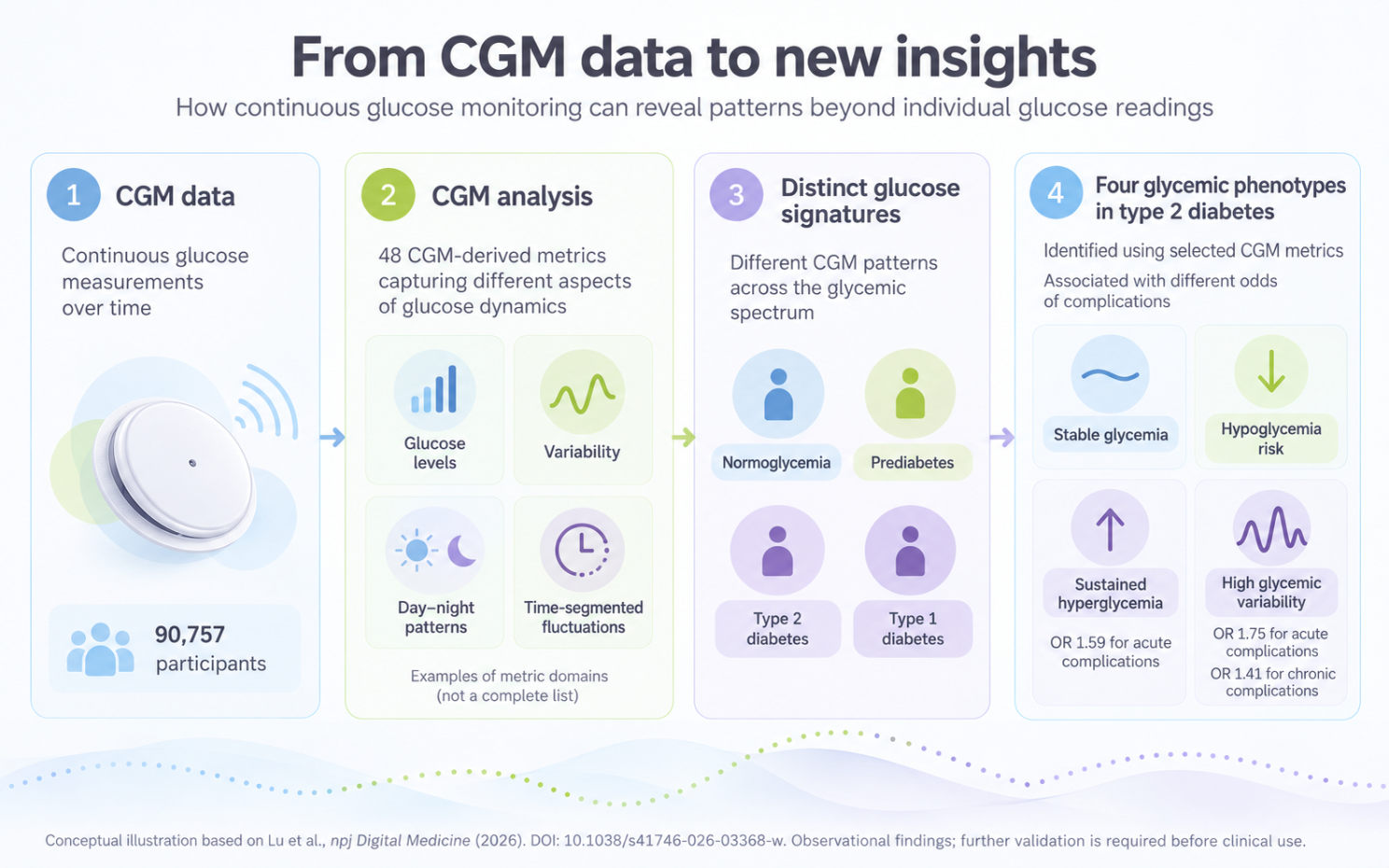
From CGM data to new insights. The study analysed 48 CGM-derived metrics from 90,757 participants and identified distinct glucose patterns across the diabetes spectrum. Among people with type 2 diabetes, four glycemic phenotypes were associated with
What could this mean for diabetes care?
Today, CGM systems primarily help people understand what is happening with their glucose levels and respond accordingly. But the enormous amount of data these devices generate may hold additional information that we are only beginning to explore.
By analysing glucose patterns over time, researchers may be able to develop digital biomarkers – measurable indicators derived from digital health data – that could help characterise individual metabolic profiles and identify potential health risks.
In the future, this could support healthcare professionals in recognising people who may benefit from closer monitoring or more personalised treatment approaches.

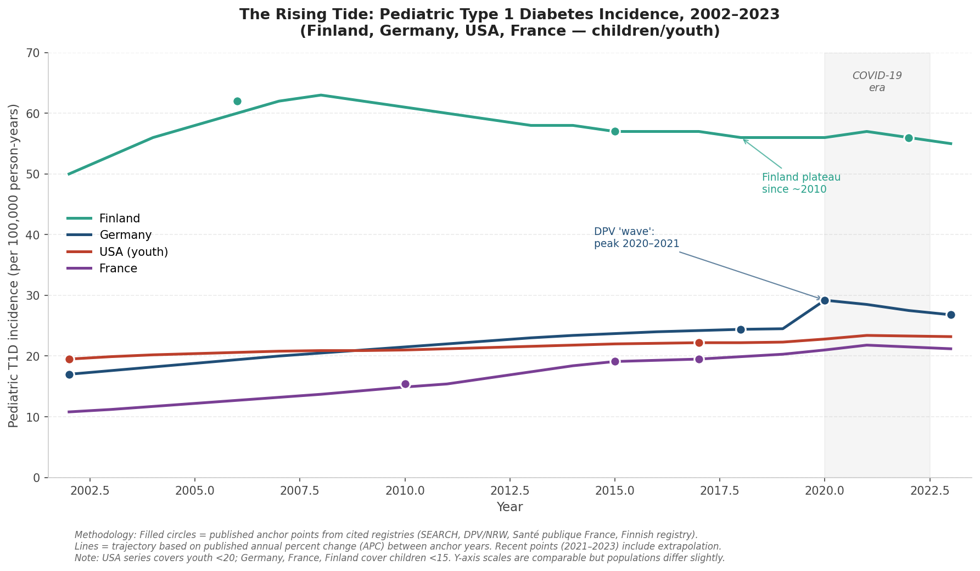
The Nordic region remains the global hotspot for childhood‑onset T1D. Finland has historically reported the highest incidence worldwide – around 60 per 100,000 children per year – although this rate appears to have stabilised or slightly declined since the early 2000s. Sweden, Norway and Denmark follow closely, and the IDF Diabetes Atlas 11 still places Finland, Sweden and Norway among the global top ten for published incidence.
A 2024 systematic review of European paediatric data (1994–2022) confirmed that the Nordic countries retain the highest absolute incidence in Europe, even as their rate of increase has slowed relative to the rapid rise in previously low‑incidence Central and Eastern European countries. A Swedish nationwide cohort study of 2.9 million children found that the heritability of childhood‑onset T1D has remained high and stable at around 0.83 over 30 years, implying that known environmental factors explain less than 10% of the observed rise.
In France, Santé publique France reports an annual T1D incidence increase of approximately 4%. Paediatric incidence rose from 15.4 to 19.1 per 100,000 person‑years between 2010 and 2015, with an overall rate of 19.5 per 100,000 in 2015–2017 and substantial regional variation. Sardinia (Italy) now reports the world’s highest published paediatric incidence at 76.3 per 100,000 (2022), having overtaken Finland, while the United Kingdom and Ireland also remain in the global top ten.
Projections to 2050
Two major modelling efforts suggest the same direction of travel. The GBD 2021 study projects that age‑standardised global type 1 diabetes prevalence will rise by about 23.9% between 2021 and 2050, a smaller relative increase than for type 2 diabetes, but a substantial absolute rise given the lifelong management burden of T1D. The IDF Diabetes Atlas 11 projects that overall adult diabetes prevalence (type 1 and type 2) will grow from 589 million in 2024 to around 853 million by 2050, a 46% absolute increase. While most of this growth is driven by type 2 diabetes, T1D contributes meaningfully through sustained or rising incidence in high‑income countries and improved survival, which increases prevalence even if incidence stabilises.
For the U.S., a modelling exercise based on SEARCH data suggests that, under a linear‑increase scenario, the number of young people with T1D could nearly triple by 2050, with the steepest relative growth among Hispanic and Black children.
Why is incidence rising?
T1D is a polygenic autoimmune disease in which environmental triggers act on a susceptible genetic background. Several, often overlapping, hypotheses are under investigation:
- Reduced early‑life exposure to common infections (“hygiene hypothesis”), with mixed evidence.
- Rising childhood adiposity and insulin resistance, which may accelerate the clinical presentation of existing islet autoimmunity (“accelerator hypothesis”).
- Viral triggers such as enteroviruses and, more recently, SARS‑CoV‑2, where meta‑analyses report a 14–27% increase in paediatric T1D incidence during the pandemic.
- Dietary and microbiome‑related factors, including early cow’s‑milk exposure, gluten timing and shifts in the infant gut microbiome.
- Vitamin D status and latitude, endocrine‑disrupting chemicals, pollution and perinatal factors such as higher maternal age, higher birth weight and Caesarean delivery.
The Swedish cohort study mentioned above is a stark reminder of how much remains unexplained: even with population‑wide data on several environmental exposures, less than 10% of the rise in T1D incidence in Sweden could be attributed to known factors. This underscores the need for long‑term birth cohorts, population‑level islet‑autoantibody screening and mechanistic immunology.
Implications for the next decade
Three practical implications stand out for health systems, innovators and the diabetes community:
- Health systems need to prepare for more people living with type 1 diabetes. Even under conservative assumptions, the number of people living with type 1 diabetes will continue to rise. This has practical consequences for insulin and sensor supply, reimbursement for diabetes technology, specialist care and clinical-trial infrastructure.
- Early detection is becoming more relevant. Type 1 diabetes can often be detected before symptoms appear, through markers of early autoimmune activity. With the first therapy now approved to delay clinical onset in people at an early disease stage, screening is no longer only a research question. Programmes such as Fr1da in Germany and the D1Ce trial in Italy show how early identification could inform future intervention strategies.
- We still need to understand why incidence is rising. Many environmental factors are being studied, but no single explanation is sufficient. Until we better understand the drivers behind the increase, true primary prevention will remain out of reach. This makes high-quality registries, long-term cohort studies and coordinated research more important than ever.
At DCB, we see these trends as both a warning and a call to action.
The rising incidence of type 1 diabetes will require sustained collaboration between clinicians, researchers, industry, policymakers and crucially people living with diabetes and their families.
Our work in innovation, clinical research infrastructure and community engagement aims to contribute to that collective effort.
Selected sources
GBD 2021 Diabetes Collaborators. Global, regional, and national burden of diabetes from 1990 to 2021, with projections of prevalence to 2050. The Lancet, 2023. https://www.thelancet.com/article/S0140-6736(23)01301-6/fulltext
International Diabetes Federation. IDF Diabetes Atlas, 11th edition. 2025. https://diabetesatlas.org/
Ogle GD, et al. Global type 1 diabetes prevalence, incidence, and mortality estimates 2025: Results from the IDF Atlas 11 and the T1D Index v3.0. Diabetes Research and Clinical Practice, 2025. https://www.sciencedirect.com/science/article/pii/S0168822725002918
Stahl-Pehe A, et al. Wave in Pediatric Type 1 Diabetes Incidence After the Emergence of COVID-19: Peak and Trough Patterns in German Youth — DPV Registry. Diabetes Care, 2025. https://diabetesjournals.org/care/article/48/4/e47/157803/
Buchmann M, et al. Type 1 diabetes incidence curves differ by age for girls and boys between 1996 and 2022: Results from the North Rhine-Westphalia Diabetes Registry. Diabetes Research and Clinical Practice, 2025. https://www.sciencedirect.com/science/article/pii/S0168822725000105
Nagl K, et al. Ongoing Increase in Incidence of Diabetes in Austrian Children and Adolescents 1989–2021. Pediatric Diabetes, 2023. https://www.ncbi.nlm.nih.gov/pmc/articles/PMC12017070/
Schoenle EJ, et al. Epidemiology of Type I diabetes mellitus in Switzerland: Steep rise in incidence in under-5 year old children in the past decade. Diabetologia, 2001. https://www.researchgate.net/publication/12017578
Santé publique France. Diabetes — Data. Updated 2024. https://www.santepubliquefrance.fr/en/diabete/data
Piffaretti C, et al. Trends in childhood type 1 diabetes incidence in France, 2010–2015. Diabetes Research and Clinical Practice, 2018. https://www.sciencedirect.com/science/article/abs/pii/S0168822718304662
Ruiz-Grao MC, et al. Trends in the Incidence of Type 1 Diabetes in European Children and Adolescents from 1994 to 2022: A Systematic Review and Meta-Analysis. Pediatric Diabetes, 2024. https://onlinelibrary.wiley.com/doi/10.1155/2024/2338922
Ji J, et al. Stable heritability of type 1 diabetes in a Swedish Nationwide Cohort Study. Nature Communications, 2024. https://www.ncbi.nlm.nih.gov/pmc/articles/PMC12174315/
D’Souza D, et al. Incidence of Diabetes in Children and Adolescents During the COVID-19 Pandemic: A Systematic Review and Meta-Analysis. JAMA Network Open, 2023. https://www.ncbi.nlm.nih.gov/pmc/articles/PMC10314307/
Quinn LM, et al. Environmental Determinants of Type 1 Diabetes: From Association to Proving Causality. Frontiers in Immunology, 2021. https://www.ncbi.nlm.nih.gov/pmc/articles/PMC8518604/
Esposito S, et al. Changes in the Global Epidemiology of Type 1 Diabetes in an Evolving Landscape of Environmental Factors. International Journal of Molecular Sciences, 2023. https://www.ncbi.nlm.nih.gov/pmc/articles/PMC10141720/
Rogers MAM, et al. Fluctuations in the incidence of type 1 diabetes in the United States from 2001 to 2015: a longitudinal study. BMC Medicine, 2017. https://www.ncbi.nlm.nih.gov/pmc/articles/PMC5688827/
Imperatore G, et al. Projections of Type 1 and Type 2 Diabetes Burden in the U.S. Population Aged <20 Years Through 2050. Diabetes Care, 2012. https://pmc.ncbi.nlm.nih.gov/articles/PMC3507562/
We hope this overview is helpful for your own work in diabetes care, research or advocacy. As always, we are grateful for your interest in and support of our activities and we look forward to continuing this conversation with you in future editions of our “DID YOU KNOW…” series.
An earlier version of this article was originally published in the private newsletter of our CEO, Derek Brandt here: Diabetes Technology News.
This post was previously published in Linkedin. Click here to see the original publication.


DCB Research AG
Freiburgstrasse 3
3010 Bern
Schweiz